Tuesday, March 13, 2018

Singapore Botanic Gardens (SBG), A Short Walk Along "Main Street"

Going past the scene of "the incident". As if nothing happened, but just so happened there was some improvement works.

Taken on 31 Aug 2017 at Palm Valley. As if the Tembusu tree was never there in the first place.
Taken on 31 Aug 2017 at Palm Valley. Note the asphalt patchwork on the pavement.

Taken on 9 Mar 2018 at Palm Valley. Note that the whole stretch of pavement was milled and re-surfaced.

Palaquium obovatum - would exudate a white latax, which is said to form a low quality rubber. Note that this tree was not protected by a barricade.

If people knew that this tree would ooze latax when its bark is cut like the rubber tree, it would be caged up as well.

Like this fella, Hevea brasiliensis or Para Rubber tree. It has some visible "scar marks" on the trunk already.

Hence this notice for people to keep their itchy hands off.

A gift from afar.

Cola gigantea planted by Nelson Mandela when he was president of South Africa in 1997. What is currently happening in South Africa is a shame though.

"its relative, Cola nitida, should be better known as it was the source of the original flavouring used in, and the name given to popular cola drinks such as Coca-cola and Pepsi-cola."
A few decades ago, there was a hoo-ha alleging that Coca-cola and/or Pepsi added cocaine to their drinks, and it was pointed that that was the reason why they were so "addictive".


"seen as a street tree in Singapore, e.g., along Alexandra Road..."
Above, some Cola gigantea photographed along Alexandra Road. Of course, looking nothing like the heritage tree aesthetic-wise.

Some larger Cola gigantea beside Kallang MRT station.

Pity that the trees along this stretch, including the adjacent Ficus trees were crown raised. Photo taken on 24 Oct 2016.

Saturday, March 10, 2018

Specifications for Soil Mixture for General Landscaping Use

Specifications for Soil Mixture for General Landscaping Use
CS A03: 2013


Formerly CS A01:2009 (Specifications for Soil Mixture for General Landscaping Use) and CS A02:2009 (Specifications for Composts and Mulches).

Seems that the Centre for Urban Greenery and Ecology (CUGE) have combined the earlier two standards into one. CS A03: 2013 sells for S$10 incl. GST at the Singapore Botanic Gardens Shop.

---

Changes from CS A01:2009 and CS A02:2009 to CS A03: 2013
1.3    Definitions, page 7 -> 1.3    Definitions, page 6

Addition of definitions of Soil Quality, Top Soil, Bioassay, Soil pH, Foreign Matter
Transfer of definitions of Pasteurisation, Compost Maturity, Plant Propagule, Mulch

Added section on soil profile in CS A03: 2013
1.4    Soil Profile, page 9

i.e., O horizon, A horizon, B horizon, C horizon, R horizon

No change from CS A01:2009 to CS A03: 2013
1.4    Soil Texture Classification, page 8 -> 1.5    Soil Texture Classification, page 8


Addition from CS A01:2009 to CS A03: 2013
1.5    Limits of the Various Classes of Soil Texture, page 9 -> 1.6    Various Classes of Soil Texture, page 11

Composition of sand, silt and clay of different soil textural class.

Changes from CS A01:2009 to CS A03: 2013
2.4    Soil Mix Composition, page 18 -> 2.1 Soil Mix Composition, page 12

CS A03: 2013 omitted soil mix composition for "general landscape uses which requires soil mix with higher porosity", and changed the soil mix composition for "general landscape applications" to 3 parts top soil, 2 parts compost and 1 part sand "by dry weight", as opposed to 3 parts clay loam, 2 parts compost and 1 part sand "by volume" in CS A01:2009.

CS A03: 2013 added a note that mixture of ASM by volume (as it was in CS A01:2009) applies only when the components have similar bulk densities. But they do not, as show below (units in g/cm3).
  • Clay loam: 1.45-1.55 [UFL IFAS]
  • Silt loam: 1.4 - 1.55 [UFL IFAS]
  • Sand loam: 1.55-1.75 [UFL IFAS]
  • Top soil: 1.0 - 1.4 [CS A03: 2013]
  • Compost (depends on type): 0.4 - 0.6 [CS A03: 2013]
  • Sand, wet : 1.9
  • Sand, wet, packed: 2                           
  • Sand, dry :1.6 [this figure is used in CS A03: 2013, page 11]
  • Sand, loose :1.45

*UFL IFAS - http://hort.ifas.ufl.edu/woody/critical-value.shtml, last modified 27 Feb 2015, accessed on 11 Mar 2018.

CS A03: 2013 continues the note with "However in practice, while mixing the top soil for ASM, soil weight should be based on the moisture content of the soil". Does it mean that the moisture content of the sand and compost components should match the moisture content of the top soil before mixing?

Changes from CS A01:2009 and addition to CS A03: 2013
2.1 Soil Mix Specifications - Physical and Chemical Requirements, page 10 -> 2.1.3  Approved Soil Mix Specification, page 16

Changed values in C:N Ratio, Bulk Density, CEC, Pathogens
Added value in Moisture Content
Deleted Permeability, Heavy Metal Concentration, Organic Contaminants

Added section to CS A03: 2013
2.1.1    Top Soil Specifications - Physical and Chemical Requirements, page 12

Changes from CS A02:2009 and addition to CS A03: 2013
2.4    Physical and Chemical Requirements, page 10 -> 2.1.2    Compost Specifications - Physical and Chemical Requirements

Deleted column for "Mulch"
Added value for Bulk Density
Changed values for Particle Size, Foreign Matter / Physical Contaminents, Pest insects / Invertebrates

Added section in CS A03: 2013
2.1.2.1    Feedstocks for Composting, page 15

Changes from CS A01:2009 to CS A03: 2013
2.2 Soil Sampling, page 16 -> 2.2 Soil Sampling, page 11

Deletion of Definition of Landscape Management Unit and Site Analysis
Addition to Number of Samples within a Landscape Management Unit
Added Representative Sampling

Changes from CS A01:2009 to CS A03: 2013
2.5 Soil Mixing, page 18 -> 2.3 Soil Mixing, page 17

Deletion from CS A01:2009 to CS A03: 2013
2.6 Basic Tools, page 19

No change in CS A01:2009 to CS A03: 2013
Section 3 - Marking and Documentation -> Section 3 - Marking and Documentation

Not common in practice.

Deletion from CS A02:2009 to CS A03: 2013
2.2 Process Criteria, page 9
2.3 Storage and Protection, page 9
2.6 Product Sampling, page 11
2.7 Application in the field, page 12

Describes how composting should be done and how long it should be composted.
Describes how finished product (matured compost) should be protected from contamination.
Describes how representative samples should be collected.
Describes how compost is used as a soil organic amendment (component of soil mix) and mulch.

Friday, March 9, 2018

Gebiz Spiral Watch

Quotation No.: HDB000ETQ18000011 (Housing and Development Board)

QUOTATION FOR INTERNATIONAL SOCIETY OF ARBORICULTURE (ISA) CERTIFIED ARBORIST FOR CONSULTANCY SERVICES, SURVEYING & RECOMMENDATION FOR NPARKS SUBMISSION FOR THE DEMOLITION OF HDB RESIDENTIAL BLOCKS 1A, 2A, 3A, 4A, 5A & 6A AT WOODLANDS CENTRE ROAD

Company A - $4,948 (Awarded)
Company B - $18,000
Company C - $7
Company D - $20,800

Lowest bid is 99.8% lesser than second lowest bid.

But maybe there is confusion over the quantity, leading to one strange quote here.
Assuming there are 1000 nos trees, then the quote by Company C may be $7000. Using this assumption, then the following applies.

Lowest bid is 29.3% lesser than second lowest bid.
Highest bid is 4.2 times (420%) more than lowest bid.

Wednesday, February 21, 2018

Uses for Wood from Pruning and Tree Felling

Just putting a thought out here. Locally, can wood with herbal and skincare properties be made into such instead of being sent to the composting factory? Even small quantities of hardwood could be made into small furniture. Would furniture makers and other hobbyists be interested to buy large hardwood logs directly from work crews? Instead of the wood - each over 1 metre in diameter - being sold to timber merchants/hoarders for $70 a piece?

Arboriculture work crews put in blood, sweat and tears, literally, and should deserve more in terms of monetary remunerations.

Even small quantities of wood in the right hardness, quality and/or properties could fetch a pretty penny. Instead of being sold to middlemen, who are only interested in colossal sized hardwood logs.

 The ubiquitous Baphia nitida or Camwood are found as periphery hedges around schools and rubbish centres. It is relatively fast growing, given that it belongs to the Leguminosae family.

 Quite a lot of wood would be taken off every time the crew comes around for pruning. As for the hedge above, the leaves were touching the ground before being pruned, so you could imagine the amount of wood being stacked up.
As a sidenote, this hedge has low and long branches ala the Tembusu tree on the Singapore $5 note, and some are "self-supporting", as they form an arch that touches the ground. I had sat on one such branch before.

 The famous leaning towers of... Acacia confusa.

Close-up

Older Acacias seem to have a tendency of "sudden death".

 Stack of logs from the relatively fast-growing Khaya senegalensis. Even a large log above 1 metre diameter would not fetch much, as so many were being felled nowadays.

These hardwood would be worth more, as the trees are slower-growing and harder than Khaya.
The one lying flat is Casuarina equisetifolia and leaning on it are Cyrtophyllum fragrans (syn.
Fagraea fragrans), or more commonly known as Tembusu.

Monday, February 19, 2018

Accumulation of leaf needles at tree base and other updates

The below would be an update for this post on de-compacting a tree base:
http://openplants.blogspot.sg/2017/05/accumulation-of-years-of-leaves-and.html

Photos taken on 14 Feb 2018.

The tree that I de-compacted the tree base still looked lush as ever, but the tree beside it actually looked worst; the leaf density decreased.

The tree base that I de-compacted (left) is starting to compact again but still appeared flatter than the one on the right.

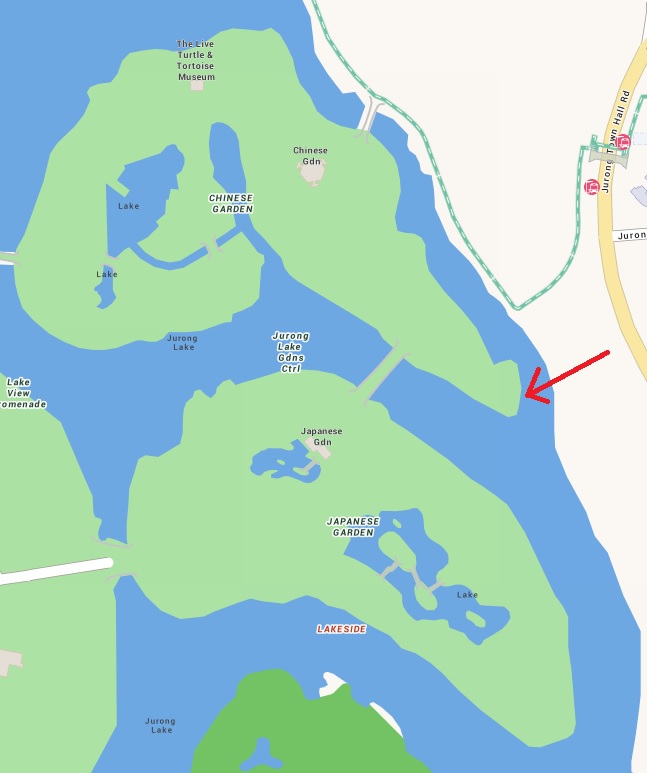
River bank failure possibly due to high velocity water. Self-sown plants were valiently holding on to the slope face but alas, it was too steep (or the water eroded away the soil it was rooted in).

Location marked with red arrow.

Lastly, one of the last few pages of the book "Trees of Our Garden City, 2nd ed" feature the iconic (at least to me) arching Callistemon viminalis, between the Chinese Garden MRT station and Garden. It was removed I think in 2016 to make way for a cookie-cutter landscaping at the peripheral of the MRT station.

Taken on 22 Sep 2014.

Taken on 14 Feb 2018.


Tuesday, February 6, 2018

Root development limited by surrounding shrubs

Shrubs surrounding a tree, Tabebuia rosea, along a roadside verge at Beach Road may have limited its spread of roots. The area is sheltered by buildings although it was located quite close to the coast. It used to be closer, hence the road name but reclaimation changed the actual moniker.

The tree may have been fine with not spreading its roots too far. But one day the leaf cover of the shrubs were taken off and coupled with the monsoon season, mercilessly dumping large volumes of rainwater onto the relatively small planting verge.

 Taken up one lane

Lifted root plate

Tuesday, January 9, 2018

Trees that can tolerate semi-shade sunlight

Frustrated that you cannot plant trees under mature trees or near tall buildings where there is semi-shade? Be angsty no more.


Species    Maximum known height    Description
1. Ardisia elliptica    8m    native; small tree, sparse columnar crown, edible small fruits
2. Artocarpus rigidus    35m    native; dense, spreading crown, edible large fruits, hard wood
3. Baccaurea parviflora    6m    native; small tree, edible small fruits, hard wood
4. Barringtonia racemosa    27m    native; sparse crown, drops flowers and seeds
5. Bauhinia purpurea    6m    sparse crown, Leguminosae

6. Brownea grandiceps   20m   sparse crown, pendulous young leaves are brown with green specks, flowers are arranged in a ball shape
7. Calophyllum soulattri    26m    native; dense, spreading crown, edible small fruits, hard wood

8. Cratoxylum cochinchinense   10m   sparse crown, pendulous leaves, flaky bark
9. Cynometra ramiflora    26m    native; dense, spreading crown, hard wood
10. Diospyros buxifolia    35m    native; sparse, spreading crown, hard wood
11. Elaeocarpus mastersii    20m    native; dense crown, edible small fruits
12. Erythroxylum cuneatum    33m    native; sparse crown, hard wood
13. Garcinia atroviridis    27m    native; sparse conical crown, edible large fruits
14. Heritiera littoralis    25m    native; sparse, spreading crown, drops seeds
15. Maniltoa browneoides    12m    sparse, spreading crown, prominent young flushes (handkerchiefs),  hard wood, Leguminosae
16. Palaquium gutta    30m    native; sparse spreading crown, hard wood (Nyatoh)

17. Saraca thaipingensis   20m   sparse crown, young pendulous flushes purplish, flowers after pronounced dry weather
18. Streblus elongatus    33m    native; sparse spreading crown, hard wood

19. Syzygium glaucum   10m   native; leaves with rounded tip, flaky bark
20. Syzygium polyanthum   30m   native; fruits eaten by birds, leaves used as spice


Some trees to feature (photos below are taken by me unless stated otherwise):

Calophyllum soulattri
 Photo taken at Hortpark, near Pasir Panjang Nursery.

Flowers

Cynometra ramiflora

This is a Cynometra cauliflora actually, but looks similar to a C. ramiflora from a distance. Flanked on the right by a Flacourtia inermis.


Different shades of young leaf flushes.

Diospyros buxifolia

Photo taken at Singapore Botanic Gardens.

Close-up on leaves. Image: Scott Zona, CC BY-NC 2.0

Maniltoa browneoides

Photo taken somewhere at a roadside in Tuas.

Prominent young flushes (handkerchiefs).

Streblus elongatus

A sapling planted behind park name signage (that is made of recycled timber). Photo taken at Tampines Eco Green.

The unique elongated flower clusters that develop at the leaf axils. Male flowers are whitish and small. Image: Cerlin Ng, CC BY-NC 2.0

And female flowers are larger, appearing almost like a large ant's head. Image: Cerlin Ng, CC BY-NC 2.0

Honourable mention: Ficus lyrata

 Multiple shoots branching - a form that is rarely seen locally. Image: Forest & Kim Starr, CC BY-NC 3.0

Ficus lyrata 12m Non-strangling fig tree, slow-growing, leaves resemble a fiddle, top the plant from an early age to encourage branching, toxic plant sap