Tuesday, June 26, 2018

Free Plant with a bag of potting mix

I got some "weed" seeds from my bag of potting mix.


 This "free" plant grew out from that potting mix.

The venation almost seemed to glow.

Sunday, May 6, 2018

Hopea sangal - a series of events across 2 years

In Sep 2002, a Hopea sangal re-discovered in Changi, which was significant as it was thought to be extinct in in the Singapore Red Data Book, and the name Changi was thought to have been originated from the tree's common name, Chengal Pasir.

Hopea sangal at Changi.
Photo credit: Tan Beng Chiak

However, the property management company taking care of the area felled the tree without the approval from authorities in November in the same year. The company's manager observed that the tree was struck by lightning and was not doing well, and decided to have the tree removed. Sivasothi who was there to check out the re-discovery was just in time to witness the felled logs from the tree being hauled away.

Hopea sangal stump.
Photo credit: Sivasothi

Logs being hauled away.
Photo credit: Sivasothi

The logs were recovered and artists carved pieces of the wood into sculptures. Some of the sculptures were exhibited at the Singapore Zoo main entrance.


Before the tree was felled, some seeds were collected by Nature Society Singapore's (NSS) members and passed to National Parks Board for propagation. After about two years of being "grown partially in a carbon dioxide enriched chamber", the sapling was more than one metre in height. Some seeds were grown by the NSS and a sapling was handed to the Singpore Zoo.

On 7 Nov 2004, Mr Lee Kuan Yew planted a sapling nurtured by NParks Pasir Panjang Nursery at Henderson Crescent, between Blocks 103 and 104.

Mr Lee planting the Hopea sangal sapling while members of parliament (MP) of the Tanjong Pagar group representation constituency (GRC) and community members look on.
Photo credit: John Yong

Google map showing approximate location of the VIP-planted tree (in red pointer).
Block numbers added by me.
Map credit: Google Maps.

I tried to locate the tree and it was found at a not so prominent spot (pointed by red arrow). 
Photo taken by me on 6 May 2018.

Overall view of the tree - the crown facing the west seemed more lush than the part facing the east, probably due to a block to the east (block 106). Note the surrounding trees that are topped.
Photo taken by me on 6 May 2018.

The tree is leaning to the north, possibly due to the phototropism as there is a block to the south (block 104) and palms (Dypsis lutescens) fighting for crown space. It is also slightly assymmetrical, as the crown is raised higher at the part where it is in contact with the palm leaves.
Photo taken by me on 6 May 2018.

Girdling root to the south of the tree.
Photo taken by me on 6 May 2018.

The plaque reads:
"Tanjong Pagar Town Council
Clean and Green Week 2004
This tree, Hopea sangal was planted by Mr Lee Kuan Yew
Minister Mentor and MP for Tanjong Pagar GRC
on 7 November 2004"
Photo taken by me on 6 May 2018.

Tuesday, May 1, 2018

"Major controversy" - an External Cavity that was not

With reference to "The Curious Incident of the Tembusu Tree that Fell" and the slew of news articles published yesterday.

The Coroner, Mr Marvin Bay referred to the last inspection of the tree on Sep 29, 2016 as a "major controversy" in the case.

In the inspection done on 29 Sep 2016, later revealed to be done by senior manager (also arborist) Thaddaeus Cheng (ISA Certified Arborist, Cert. ID: SG-0621A), found a 1.5m long "cavity". His supervisor, deputy director Elango Velautham, "also inspected the tree as a follow-up to Mr Cheng’s report". He noted that a "flute" was "wrongly perceived" as a cavity at the Coroner's Inquiry on 30 Aug 2017.

However in the news article on 30 Apr 2018, it was written that Elango Velautham explained during the inquiry that upon further inspection, that he found that "it was not an external cavity and that there was no decay", and the arborist used the word "cavity" due to the limitation of the inspection form.

So was it "wrongly perceived", or was it "rightly perceived but written wrongly"? And again, it was not known whether the "wrong perception" was discovered before or after the tree fell.

Also during the inquiry on 30 Aug 2017, the lawyer acting for Angara's family had questioned "the absence of documentary proof showing how the misdiagnosis was determined". Perhaps that statement lead to the Coroner remarking that it would be useful that tree inspections for large and old trees be accompanied by photographs, which "can allow a more cogent analysis of the actual baseline health of the tree".

A flute of an Angsana tree in Clementi.

---
Some cheem words found in the news articles:

Cadre - a group of trained or otherwise qualified personnel capable of forming, training, or leading an expanded organization, as a religious or political faction, or a skilled work force.
"They hoped to form a cadre of veteran party members."
 Cogent - (of an argument or case) clear, logical, and convincing.
"They put forward cogent arguments for British membership."
Obviate - avoid or prevent (something undesirable).
"A parachute can be used to obviate disaster."
Remiss - lacking care or attention to duty; negligent.
"It would be very remiss of me not to pass on that information."
Wherewithal - the money or other means needed for a particular purpose.
"They lacked the wherewithal to pay."

Coroner's Findings on Tembusu Tree that killed a woman at Singapore Botanic Gardens

Death of woman killed by tree at Botanic Gardens a tragic misadventure, coroner rules

Wong Pei Ting TodayOnline 30 Apr 2018

SINGAPORE — No one, not even experts, could have seen it coming that a Tembusu tree at the Singapore Botanic Gardens would topple and cause the death of a 38-year-old woman in February last year, a coroner said on Monday (April 30).

However, the family of the deceased, Indian national Radhika Angara, are “stricken” with grief by the finding, which ruled her death as a “truly tragic misadventure”.

They still believe it was the “inaction” of the National Parks Board (NParks) that caused the woman to die.

Ms Angara’s sister Aarti Angara, on behalf of her parents and brother-in-law Jerome Rouch-Sirech, said: “Everything we heard over the course of this inquest, suggested to us that the people-in-charge were remiss in their duties to keep the public safe at a Unesco world heritage site.”

Referring to the inquiry, which uncovered that at least 70 per cent of the 270-year-old heritage tree’s core was decayed, she added: “These people have the tools and the wherewithal to prevent this mishap… This could have and should have been prevented. Instead it is my niece and nephew who will have to bear the burden of this disaster, and who will never get to know their mother.”

Ms Radhika Angara, who was regional digital marketing head for Asia-Pacific at MasterCard, is survived by her French husband, Mr Rouch-Sirech, and twins Chloe and Rafa, who are two years old.

She was carrying Rafa in her arms when she was hit by the 40m-tall tree last year on Feb 11. Rafa suffered abrasions on his limbs and contusions on his head, while his mother died of fractured ribs and traumatic asphyxia when she could not breathe after being pinned under the tree.

Mr Rouch-Sirech covered his face with his hands as Coroner Marvin Bay delivered his findings after a four-day inquest that was held over a period of about nine months. He left the courtroom crying.

In a 19-page report, Mr Bay ruled that Mr Thaddeus Cheng, the NParks’ arborist (tree doctor) responsible for the massive tree’s last inspection in September 2016, followed existing protocol. The tree was checked twice a year for the presence of open cavities.

Mr Cheng and his supervisor, Mr Elango Velautham — who also inspected the tree as a follow-up to Mr Cheng’s report — could not have detected the presence of decay unless they performed an advanced inspection, which would require the use of diagnostic tools such as a resistograph and sonic tomographs.

Mr Bay noted that their most significant discovery did not warrant that level of inspection. The men had taken note of a 1.5m long flute that is 30cm at its widest point and 20cm deep at its deepest point, although no decay was found.

The higher-level assessments only kick in if there are reasons to suspect internal decay or any issue that might affect structural integrity.

In this case, Mr Elango, who is the deputy director of Botanic Gardens' Arboriculture and Plant Resource, testified that a massive internal cavity extending a height of 2.9m was only discovered after the tree had uprooted on Feb 11 last year.

Although the cavity was close in distance to the flute structure, it was hidden inside the trunk, he said.

NParks lead arborist Abdul Hamid, along with two other independent arborists — Mr Rick Thomas of ArbourCulture and Mr Derek Yap of Camphora — submitted that the collapse could not have been predicted.

Accepting NPark’s account, Mr Bay said that heavy rainfall and strong winds of 30 to 40km/h in the week leading up to the accident contributed to the tree’s collapse, besides its weak trunk.

“The wind had initiated the process by buffeting the 40m-tall tree (with an asymmetric canopy load), causing considerable swaying. The swaying had transferred these strong imposed forces down the trunk and, in turn, caused the degraded tension roots to fracture,” he said, adding that the tree has a shallow root depth of just 70cm at its maximum.

Explaining how the decay started, Mr Bay said that in the distant past, the roots of the tree were cut to build a path nearby, so they became degraded when they could not propagate further. The cuts also allowed pathogens to be introduced into the tree’s system, causing severe decay in the roots below soil level.

The rot eventually migrated to the trunk itself, leading to massive internal decay.

Two months after the accident, National Development Minister Lawrence Wong said in a parliamentary response that as of November 2016, an enhanced inspection regime involving the use of diagnostic equipment were put in place for large trees that are older than 50 years old.

Mr Bay called the change a positive step, which “will do much to obviate the risk of a sudden and potentially catastrophic tree failures in the future”.


Tembusu tree accident: Death of woman a 'tragic misadventure', says coroner

Jalelah Abu Baker Channel NewsAsia 30 Apr 2018

The tree's deterioration started in the "distant past" when its roots were cut to make way for a path, Coroner Marvin Bay said.

SINGAPORE:  The death of a 38-year-old woman who was killed by a Tembusu tree which uprooted at the Singapore Botanic Gardens last year was a tragic misadventure.

That was Coroner Marvin Bay’s finding on Monday (Apr 30), two weeks after the conclusion of an inquiry into the death of Indian national Radhika Angara.

Mr Bay noted that there were no external signs or symptoms of an internal decay, a point raised by arborists who had testified during the inquiry. An external void was flagged in 2016 during an inspection, but that turned out not to be damage.

"No other feature was documented about the tree which would have raised the index of suspicion that it was susceptible to imminent collapse," he said.

Strong winds and heavy rain in the days before the tragic incident was a factor in the "final failure" of the tree's roots, said the coroner. The wind had initiated the process by buffeting the tree, causing "considerable" swaying, he added.

This in turn caused the tree's already weakened roots to fracture.

The incident happened on Feb 11, 2017, when Ms Angara was at the UNESCO world heritage site with her husband and now two-year-old twins. She was killed when the 40m-tall tree fell on her. Four others, including her husband and children, were injured.

Ms Angara's husband, French national Jerome Rouch-Sirech, sat with his face in his hands most of the time while the coroner delivered his finding.

Her sister Aarti was also in court. Speaking to reporters on behalf of the family, she said it was inaction by the people in charge that led to the tragedy. It could have been prevented, she added, saying her niece and nephew will now have to "bear the burden of this disaster, and will never get to know their mother".

Breaking down, she said: "Sitting here today, we had to relive the day of the tragedy and what caused her death. That has just been gut-wrenching."

Meanwhile, Mr Rouch-Sirech covered his face and sobbed.

PROGRESSIVE DECAY OF 270-YEAR-OLD TREE

While there were no visible signs of an internal decay, the roots of the 270-year-old heritage tree had in fact deteriorated over time.

In his findings, the coroner pointed to the tree's "distant past" when its roots were cut to build a path nearby. As a result, the roots were unable to spread further and become degraded.

This already "dire" situation was worsened by a severe decay of the roots below soil level.

"This was also associated with the same root cuts that had occurred in the past which had at some point introduced pathogens which had caused progressive decay," said Mr Bay.

The decay eventually migrated to the trunk, causing "massive internal decay" he added.

Protocol that existed at the time was followed, said Mr Bay, but he noted that it would be useful for photographs to be taken during all regular tree inspections for significant trees such as old and large trees, or heritage trees.

"These recorded images would be useful in investigations and inquiries, as an archive of contemporaneously taken photographs of the same tree can allow a more cogent analysis of the actual baseline health of the tree," he said.

This would afford longitudinal tracing and visual examination over years or even decades, he added.

Such decay can currently be uncovered through advanced inspection, he observed. This is done if the arborist conducting checks suspects internal decay or any other issue that might affect structural integrity.

THE LAST INSPECTION IN SEPTEMBER 2016

Mr Bay referred to the last inspection of the tree on Sep 29, 2016 as a "major controversy" in the case. Senior Counsel Chelva Rajah, who represented Ms Angara’s family, had articulated his suspicions about an "external cavity", as documented by an arborist who inspected the tree, and why it had not been addressed before the tree collapsed.

Singapore Botanic Gardens’ deputy director Elango Velautham, the supervisor of arborist Thaddeus Cheng, had explained during the inquiry that the arborist noted a space that "looked unusual" and recorded it as a cavity without decay.

Upon further inspection, Mr Elango found that it was not an external cavity, and that there was no decay. It was in fact a flute, which is a fold in the surface of the tree, and Mr Cheng had used the word "cavity" due to limitations in the form he submitted.

The Tembusu tree that fell was inspected twice a year, as are other large heritage trees, trees in carparks and those in areas where "the occupancy rate is high", Mr Velautham had said during the inquiry, which took place over four days spread out over a period of about nine months.

In response to Channel NewsAsia's queries, the National Parks Board said: "NParks notes the Coroner’s findings that this was a tragic misadventure and will study the Coroner’s report."

Source: CNA/ja/(gs)

Monday, April 30, 2018

Gebiz Spiral Watch

Quotation No.: HDB000ETQ18300071

QUOTATION FOR ISA CERTIFIED ARBORIST CONSULTANCY SERVICES FOR THE PROPOSED PUBLIC HOUSING DEVELOPMENT AT KALLANG WHAMPOA KWC57

Company A - $7,713
Company B - $8,800
Company C - $3,008 (Awarded)
Company D - $4,000

Company C seems like a relatively new-comer to the local arboriculture and landscaping scene and  claimed to be doing business since 2005. Winner had bidded 25% lower than the second lowest bidder.

Quotation No.: HDB000ETQ18300057

Quotation for ISA certified arborist consultancy services at demolition site at Bedok South Avenue 3

Company A - $12,000
Company B - $3,897 (Awarded)
Company C - $8,800
Company D - $4,500
Company E -  $12,500
Company F -  $8,155

Winner's price was 13% lower than the second lowest bidder, who in turn is about half that of the median price. More newcomers are bidding than the established ones. Surprisingly, one of the company who was under-pricing everyone not long ago is now at the median.

Quotation No.: HDB000ETQ18300004

Quotation for ISA certified arborist consultancy services for demolition of industrial blocks at Sin Ming Industrial Estate

Company A - $4,998 (Awarded)
Company B - $13,500

Winner's price was 63% lower than the other company. This job seemed as good as any, but strangely there was only two bidders.

Quotation No.: HDB000ETQ18300097

QUOTATION FOR ISA CERTIFIED ARBORIST CONSULTANCY SERVICES FOR THE PROPOSED TOA PAYOH NEIGHBOURHOOD 1 CONTRACT 25/25A AND PARK


Company A - $4,200
Company B - $7,430
Company C - $4,200 (Awarded)
Company D - $4,650
Company E -  $8,205

Winner's price was  10% lower than the second lowest bidder. Company C was the same company in Quotation No.: HDB000ETQ18300071, and was also the awarded company. As a relative new-comer to the scene and/or Gebiz bidding circle (for arborist), they managed to win over Company A, which was bidding at the same price and seemed to be more established in the industry.

Saturday, April 28, 2018

LTA Car Crashed into OG Boxes Before Being Stopped by Tree

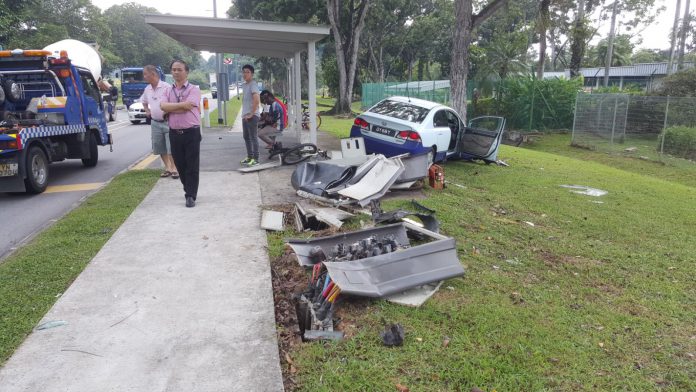
On 26 April 2018 (Thursday) around 2.30pm, an Land Transport Authority (LTA) car crashed into overground (OG) boxes before smashing into a tree along Kranji Way. Swietenia macrophylla (Broad-leafed Mahogany; Honduran Mahogany) no less. The incident also involved a Kranji Countryside Association minibus, which goes along a set route and brings visitors to farms in Kranji. A spokesperson from the LTA said that no injuries were reported - either to the driver of the LTA car, and driver and passenger in the minibus. A Mobike (sharing economy bicycle) appeared to be toppled in the path of destruction. The tree with its apparent buttress roots remained standing and a  large wound appeared to have been created at the point of impact.

Photos credited to a "Taxi Poh", with exception to the first photo.

 Screenshot captured on Google Streetview dated Sep 2015.

 Minibus involved in the incident with the damaged OG boxes and car in the background.

LTA car smashed into Swietenia macrophylla tree.

 Along Kranji Way near the Sungei Buloh Wetland Reserve Visitor Centre (60 Kranji Way) and Kranji Reservoir Carpark B.

 Damaged OG boxes and toppled Mobike in the path of destruction.

Another view of the point of impact. No obvious soil movement and uprooting despite the impact from the car.

One online commenter asked - "If you hit a tree..... Does nparks come after you?"

NParks said that when roadside trees are hit and damaged by a vehicle and if established that it was due to recklessness, negligence or intoxication of the motorist, the motorist may be fined, starting from $2,000 a tree. The motorist may also have to pay for the damage caused. And that I suppose refers to "making good" based on the value of the tree, which depends of the age, size and type of the tree.

Sunday, April 22, 2018

Can tree management reduce trees overturning during storm events?

Some trees fall during storm events in strong wind and rain (these trees were termed as windthrow or wind snap in the paper below) but some trees managed to stay upright. So what factors contributed to these trees to stand firm while the others to fall? For this entry, the following paper would be referred to heavily.

Source: Moore GM 2014, Wind-thrown tree: Storms or management? Arboriculture & Urban Forestry 40(2):53-69


There is a Chinese saying that "big trees attract more wind", and that is true but there is also the assumption (not just by the Chinese) that tree crowns act like sails on a boat/ship, and the total surface area of the foliage were taken in the past. But doing that overestimated the wind force exerted on the tree. Rather, tree crowns behave more like a perforated sieve.

I do not know if calculation were made to estimate wind forces exerted on "sails" or "sieves" for the trees locally, but crowns were reduced or tree were removed I suppose to show that something is being done. It is not clear that crown reduction to reduce the foliage surface area would necessarily reduce the wind load, because depending on which branches are removed, the capacity for mass damping (see previous blog post) may also be diminished.

Most tree roots are near the surface and spreads 3-4 times the spread of the tree crown (also known as the drip line). There are different types of roots in the root system - descending (or vertical, sinker, or oblique) roots, spreading roots, tap roots, and fine roots. Fine roots bind closely to the soil and consolidate the root plate as they are large in number and surface area.

Structural roots are important to tree stability and have to be protected within a critital root zone (Matheny and Clark 1998, Anomymous 2009), or structural root zone (SRZ) - same meaning.
Anonymous, 2009. Protection of trees on development sites, Australian Standard # 4970, Standards Australia, Sydney.

Roots that contribute to the anchorage are the resistance of leeward roots to bending (25%) and the resistance of tap roots and decending roots to uprooting (75%). Therefore the windward roots, which is pulled upwards during toppling, is the most important component in resisting windthrow. When they do get pulled up, the descending roots, if present, often follow intact. If there are no descending roots in the exposed windward side, it is often an indication that they have not been present, which may be important in diagnosing the causes of failure. Failure usually occurs closer to the trunk in wet soils.

Other professions (geotechnical, civil engineering, etc.) have noted the important of descending roots in stabilising slopes, with deeper rooted trees stabilising slopes only to the depth to which descending roots can penetrate (Gray and Sotir 1996).
Gray DH and RB Sotir. 1996. Biotechnical and soil bioengineering slope stabilisation. Wiley and Son, New York City, New York, U.S.

Root plates are often depicted as being circular but that is a simplified approximation. A study suggested that an elliptical root plate may be a better approximation to reflect root systems (based on two Pinus species).

Figure 5 below was flipped horizontally to match the directions in Figure 4. It was the other way around in the original paper, which is strange. The root plate is more likely to extend to the windward side of the trunk, and damage to anchoring roots at that side, by trenching or construction, is more likely to lead to the root plate tilting (Figure 4). Especially if the roots are damaged or severed close to the trunk. Mowing could have also repeatedly damaged the lateral root that had come to the soil surface. While the wounds created may not be structurally imparing, they may provide access for pests and diseases into the tree. A number of them would start to decay and desending roots would also die along, causing the tree more prone to toppling by wind.

Construction work such as adding backfill soil or re-contouring surfaces could divert water flows away from the root systems, and pose sudden water deficits to the trees, which would show signs of wilting and dieback. However, many trees with significant dieback could remain standing while trees with healthy crown could be wind-thrown. Hence caution should be applied when observing the crown in visual assessments. Signs of dieback and significant deadwood in the crown may also indicate that the trees may have been stressed for some time and that there had been a loss of root mass.

A study have shown that depth of root plate is not significant in tree failure. In addition, urban soil profiles are altered and compacted such that penetration by tree roots is limited to no more than 1000mm depth. In the case where soils are compacted near the surface - at heavily trafficked areas of a park, sports activities, people grouping under trees for shade - reduces aeration and water penetration. This in turn inhibit descending and lateral roots, which can affect tree stabililty. However, compaction increases soil strength.


Heavy rains would saturate soil and reduce the strength of the connection between soil and tree roots, resulting in trees overturning and the descending rotos of the root system of the windward side would be intact. Soil may also be waterlogged due to poor drainage or altered subterranean water flows. Due to "high water table", root developement could be restricted to depth of 200mm and above.  In waterlogged soils, desending roots would die back over time. After the tree had been overturned by wind in such a case, the exposed soil would have a pungent odour and there would be a large number of small blackened roots. 

Management may have contributed to forest tree failure after forest thinning operations, which has been well-researched because of the economic losses that results. Due to heavy rains that reduce soil strength and accompanying strong winds. I would argue that this applies to urban trees and shrubs thinning as well.


Standard protection systems cannot deal with the nuances of every tree and root system that develop in response to particular environments.

Arborists should include as part of their inspection protocols, trees that show damaged or decayed lateral roots and the loss of descending roots, evidence of site or trenching work close to the trunk, and whether trees are growing in compacted soil, waterlogged soil and backfilled soil. However in my opinion, I do not think an arborist could observe loss of descending root and waterlogged soil.

The question is raised as to whether the storm was the final trigger in a lengthy chain of events relating to tree management, leading to wind-thrown and whole-tree failure.