The below is a review of a few tenders on GeBiz (Singapore government tendering platform) for arborist services. For the first two tenders the quotes were competitive, as they were quite close to one another. As for the rest of the tenders, the lowest bidders were just undercutting everyone else. Could they even cover their overheads with that kind of asking price?
In all cases, the lowest bidders won the tender. Currency in Singapore dollars.
Quotation No.: DEFEPS3000024993 (Ministry of Defense)
Company A - $24,000
Company B - $15,360
Lowest bid is 36% lesser than second lower bid
Quotation No.: HDB000ETQ16000520 (Housing and Development Board)
Company A - $3500
Company B - $2696
Lowest bid is 23% lesser than second lower bid
Quotation No.: JTC000ETQ16000105 (JTC Corporation)
Company A - $60,000
Company B - $12,000
Company C - $29,500
Company D - $2998
Lowest bid is 75% lesser than second lower bid
Quotation No.: HDB000ETQ16000490 (Housing and Development Board)
Company A - $15,050
Company B - $13,300
Company C - $4,650
Company D - $10,000
Lowest bid is 53% lesser than second lower bid
Quotation No.: JTC000ETQ16000100 (JTC Corporation)
Company A - $2000
Company B - $1800
Company C - $1100
Company D - $2936
Company E - $700
Company F - $13 (8+5)
Lowest bid is 98% lesser than second lower bid
There may have been a misunderstanding of the quantity that was being bidded for by Company F. There were two items to bid for and combined to give the final bidding price. Item 1 is to assess the first 10 trees, and item 2 is to assess the next trees in blocks of 10. For example, the contract owner could choose to have the first 10 trees assessed based on item 1's price, and the next 30 trees assessed based on item 2's price times 3 (30 divided by 10 is 3).
Company F may have misunderstood that the bidding was based on the assessment of one tree.
If the latter was true, then his bid should be $130, and hence the lowest bid was 81% lesser than second lower bid.
Will this model of competitive bidding be sustainable when competitors are bidding on average >50% lesser than the next company?
Saturday, January 28, 2017

Saturday, December 10, 2016
Price of Tree Climbing Gear
Recently the National Parks Board called a tender for the procurement of tree climbing equipment. Quotation No. NPB000ETQ16000106
The winners and the gear being bought from them are as follows:

Of course, the prices are being set differently from retail price due to the bidders being on a competitive platform, and regular tree climbing hobbyists may not be able to get the same prices. If including climbing ropes, which are not shown here, a beginner climber may be looking to spend $2000-2500 to own a complete tree climbing set.
The winners and the gear being bought from them are as follows:
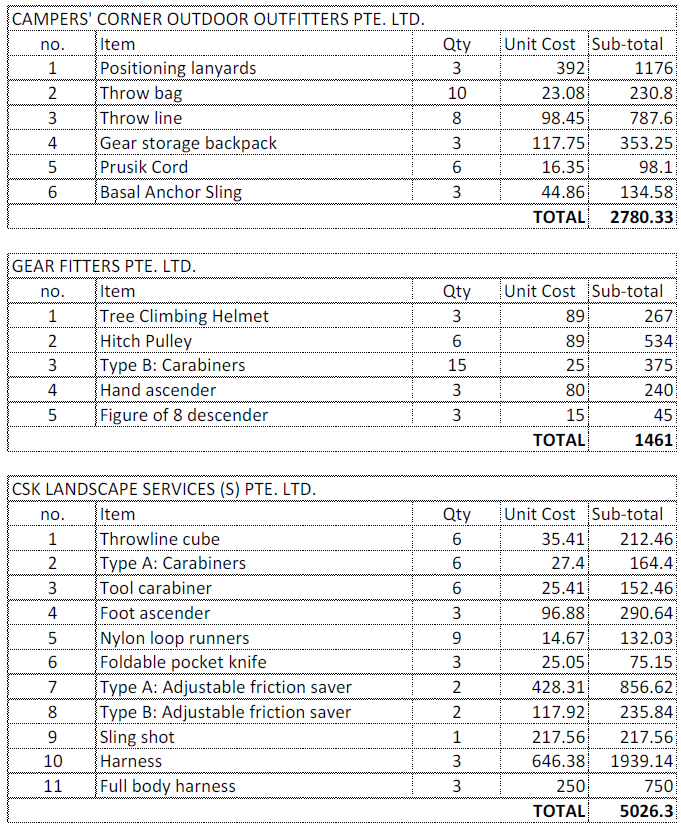
Prices are in Singapore Dollars.
Of course, the prices are being set differently from retail price due to the bidders being on a competitive platform, and regular tree climbing hobbyists may not be able to get the same prices. If including climbing ropes, which are not shown here, a beginner climber may be looking to spend $2000-2500 to own a complete tree climbing set.
Friday, December 9, 2016
Climbing Helmet vs Industrial Helmet
Arborists who do climbing would be familiar with the climbing helmet, which mountaineering hobbyists/workers would use as well. Some arborists who are doing just ground-based work took to wearing a climbing helmet maybe because: a. they do not have a "usual" helmet at hand, b. they look more like an arborist with a climbing helmet, or c. they look safety conscious wearing just any helmet.
So should those arborists be wearing a climbing helmet when they are confined to the ground? Let's explore a bit on the climbing helmet first.

Climbing helmet that an arborist was selling through Facebook.
Arborists who does climbing generally adopt the climbing helmet that complies with the BS EN 12492 standard. The tests that the helmet go through are as follow:


The general industrial helmet or commonly known as the "safety helmet" generally complies to the EN 397 standard, and the tests they go through, as compared to the EN 12492 climbing helmet are as follows:
 An industrial helmet with chin strap. A basic model should not cost more than $10.
The main differences are reflected above are that as compared to the climbing helmet, the industrial helmet does not offer protection from impact to the side, and the chin strap breaks with less force applied. I am not a safety expert and cannot offer my opinions on what these variations mean, but as the saying goes, use the right tool for the right job.
Ask yourself: if not in an environment with falling hazards and not in a construction site, is wearing a helmet necessary?
P.S. Some arborist-looking helmets may look like the real deal and may even try to pass themselves off as one, but they are often of the EN1078 standard, which applies mainly to cyclist helmets.
So should those arborists be wearing a climbing helmet when they are confined to the ground? Let's explore a bit on the climbing helmet first.

Arborists who does climbing generally adopt the climbing helmet that complies with the BS EN 12492 standard. The tests that the helmet go through are as follow:
- Withstand a 5kg falling mass from 2m height on the top of the helmet.
- Withstand a 5kg falling mass from 0.5m height on the side of the helmet.
- Not break from a sharp 3kg falling mass from 1m height on the top of the helmet.
- Withstand a 500N for on the chin strap.
- Not slip from the wearer's head when a 10kg falling mass is applied on the edge of the helmet.


The general industrial helmet or commonly known as the "safety helmet" generally complies to the EN 397 standard, and the tests they go through, as compared to the EN 12492 climbing helmet are as follows:
- Withstand a 5kg falling mass from 1m height on the top. (fall from 1m shorter)
- Not break from a sharp 3kg falling mass from 1m height on the top. (same)
- Withstand a minimum force of 150N and no more than 250 N on the chin strap.
- (Half of the force applied. This is to ensure that the chin strap holds but the user is not strangled if he gets stuck.)
- Not catch fire after 5 seconds when exposed to a bunsen burner for 10 seconds. (climbing helmet does not have this test)
- No test for falling mass on the side of the helmet.

The main differences are reflected above are that as compared to the climbing helmet, the industrial helmet does not offer protection from impact to the side, and the chin strap breaks with less force applied. I am not a safety expert and cannot offer my opinions on what these variations mean, but as the saying goes, use the right tool for the right job.
Ask yourself: if not in an environment with falling hazards and not in a construction site, is wearing a helmet necessary?
P.S. Some arborist-looking helmets may look like the real deal and may even try to pass themselves off as one, but they are often of the EN1078 standard, which applies mainly to cyclist helmets.
Wednesday, November 30, 2016
Secure by Design
Horticulture Week (UK) reported a local police force has suggested design and plant species to help keep the backyard from bunglers.
Article
Video
In Singapore's context, some plants (with the exception of the obvious cactus) that serve the same purpose would include:
Suitable for small spaces

Bougainvillea
Photo credit: Joel Abroad - https://www.flickr.com/photos/40295335@N00

Caesalpinia pulcherrima (Peacock Flower)
Photo credit: kimubert - https://www.flickr.com/photos/treevillage

Duranta erecta or Duranta erecta 'Variegata' (Golden Dew-Drop)
Photo credit: Hildegard Chen - https://www.flickr.com/photos/hildegardtschen

Lasia spinosa (Geli-geli)
Photo credit: Cerlin Ng - https://www.flickr.com/photos/89906643@N06
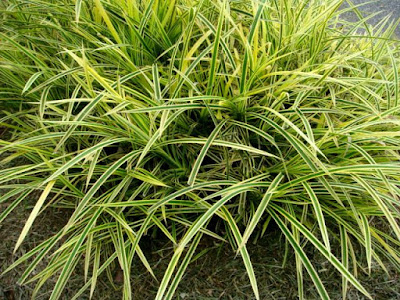
Pandanus pygmaeus (Dwarf Screwpine)
Photo credit: Ahmad Fuad Morad - https://www.flickr.com/photos/adaduitokla
Suitable for large spaces
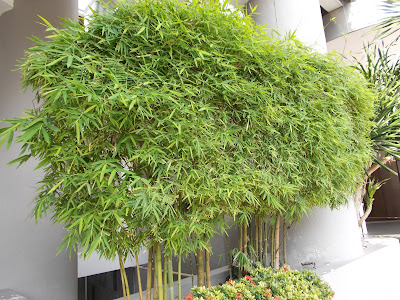
Bambusa multiplex or Bambusa vulgaris (Bamboo small or Bamboo large, respectively)
Photo credit: techieoldfox - https://www.flickr.com/photos/techieoldfox

Oncosperma tigillarium (Nibong Palm)
Photo credit: Forest and Kim Starr - https://www.flickr.com/photos/starr-environmental

Licuala spinosa (Mangrove Fan Palm)
Photo credit: author

Zamia furfuracea (Cardboard Palm)
Photo credit: Forest and Kim Starr - https://www.flickr.com/photos/starr-environmental
Article
Video
In Singapore's context, some plants (with the exception of the obvious cactus) that serve the same purpose would include:
Suitable for small spaces

Bougainvillea
Photo credit: Joel Abroad - https://www.flickr.com/photos/40295335@N00

Caesalpinia pulcherrima (Peacock Flower)
Photo credit: kimubert - https://www.flickr.com/photos/treevillage

Duranta erecta or Duranta erecta 'Variegata' (Golden Dew-Drop)
Photo credit: Hildegard Chen - https://www.flickr.com/photos/hildegardtschen

Lasia spinosa (Geli-geli)
Photo credit: Cerlin Ng - https://www.flickr.com/photos/89906643@N06

Pandanus pygmaeus (Dwarf Screwpine)
Photo credit: Ahmad Fuad Morad - https://www.flickr.com/photos/adaduitokla
Suitable for large spaces

Bambusa multiplex or Bambusa vulgaris (Bamboo small or Bamboo large, respectively)
Photo credit: techieoldfox - https://www.flickr.com/photos/techieoldfox

Oncosperma tigillarium (Nibong Palm)
Photo credit: Forest and Kim Starr - https://www.flickr.com/photos/starr-environmental

Licuala spinosa (Mangrove Fan Palm)
Photo credit: author

Zamia furfuracea (Cardboard Palm)
Photo credit: Forest and Kim Starr - https://www.flickr.com/photos/starr-environmental
Monday, November 21, 2016
Feet of the Five Trees
The title above would be the literal translation of "gor zhang chiu kar", the name of the five transplanted trees, or rather that of their predecessors at Esplanade Park. But Nparks went with the milder sounding "under the shade of five trees.


One of the five Angsana trees. Average girth of the five: 1.48 m (diameter 0.477 m)

Screengrab from Nparks Youtube showing Raintree being transplanted. Went quite viral.

As explained in this signage, that Raintree was one of the eight being transplanted around Victoria Concert Hall. The Raffles statue was of course wrapped up and protected from possible damage.

One of the eight Raintree at its transplanted pit.
Wooden decking installed over the pit.

Held up by metal struts due to the lean.

Interface between a strut and one of the major branch.
 Bravo, even the arboriculture consultant is listed on the "project mainboard".

Thursday, November 10, 2016
Rosewood and Teak Timber Harvested Till Near Extinction
Rosewood trees in the Thailand-Cambodia-Laos region and elsewhere, and Burmese Teak are being overly exploited too feed the growing appetite for carved furniture and flooring. In China, an intricately furniture crafted in an antique style could fetch one or two million US dollars.
An alternative flooring material is bamboo. Its as hard as teak but it has no grain pattern (as it is in the grass family) and does not last as long. Teak is the best in decay, insect and termite resistance (check out the longest and oldest teak bridge in Asia - U Bein Bridge in Myanmar). Other alternatives are palms like Coconut and Sugar palm, surprise surprise. The planks (can't really call them timber) from palms appear to have black fibers surrounded by a lighter coloured body. The center of the tree is soft and does not have any vascular bundles. This is contrast to the tropical tree species where the outer sapwood and heartwood could be both as hard. The wood of these palms are usually harvested after they have passed their time of fruit-bearing of 50-70 years. Both species are not listed in the CITES Appendices or on the IUCN Red List of Threatened Species.

Oncosperma tigillarium or Nibong is a candidate to join the two species in alternative flooring material. In addition to being decay-resistant, it is also saltwater, borer and termite resistant. Its current use is in building boats, for poles in kelongs, and the large marine fish traps used in Malaysia and Indonesia. However, even this alternative are being over-harvested, and kelong owners who traditionally use them as piles have to switch to hardwoods, which could cost 6 times more. (Source: https://sites.google.com/site/thehumanitiesempanadas/geography-of-food/kelongs-soon-to-be-an-image-of-the-past)

China consumes most of these Rosewood, as there seemed to be a desire among the nouveau-rich to collect such antiques, or rather antique reproductions to show off their wealth. The Rosewood utilised was not only one species - Dalbergia cochinchinensis or Siamese Rosewood pilfered from their southern neighbours - but according to the National Rosewood Standard of China, 33 species in total are considered as Rosewood. One of those species is, surprise again, Pterocarpus indicus or Angsana, a relatively fast-growing tree commonly planted in the Philippines (National tree of Philippines), Malaysia, Singapore, and some say Indonesia. A fungal disease epidemic by fusarium wilt impacted the Angsana population in Singapore in the 1980s and almost wiped them out.
In the early 1990s, the National Parks Board sourced Angsana seeds from the region, grown them, and identified those resistant to the fusarium wilt. Some fruits of their research are exemplified in five fungal wilt-resistant Angsana trees that were nurtured in Bidadari and transplanted to Esplanade Park one year ago. But sometimes, there is still a small number of trees that succumb to the disease.
In conclusion, Angsana is a potential candidate for a Rosewood plantation, as a specimen of 40cm diameter could be grown within 20 years (using the ones in Esplanade as an example), as compared to 40 to 50 years for Siamese or Malagasy Rosewood of 20 cm in diameter.

An alternative flooring material is bamboo. Its as hard as teak but it has no grain pattern (as it is in the grass family) and does not last as long. Teak is the best in decay, insect and termite resistance (check out the longest and oldest teak bridge in Asia - U Bein Bridge in Myanmar). Other alternatives are palms like Coconut and Sugar palm, surprise surprise. The planks (can't really call them timber) from palms appear to have black fibers surrounded by a lighter coloured body. The center of the tree is soft and does not have any vascular bundles. This is contrast to the tropical tree species where the outer sapwood and heartwood could be both as hard. The wood of these palms are usually harvested after they have passed their time of fruit-bearing of 50-70 years. Both species are not listed in the CITES Appendices or on the IUCN Red List of Threatened Species.

Palm "wood" flooring
Oncosperma tigillarium or Nibong is a candidate to join the two species in alternative flooring material. In addition to being decay-resistant, it is also saltwater, borer and termite resistant. Its current use is in building boats, for poles in kelongs, and the large marine fish traps used in Malaysia and Indonesia. However, even this alternative are being over-harvested, and kelong owners who traditionally use them as piles have to switch to hardwoods, which could cost 6 times more. (Source: https://sites.google.com/site/thehumanitiesempanadas/geography-of-food/kelongs-soon-to-be-an-image-of-the-past)

Nibong palm at Singapore Botanic Gardens, Swan Lake or something
Near the border with Cambodia, Thailand posted their soldiers to patrol the last tracts of old-growth Rosewood trees in nature reserves and post guards to watch over their largest remaining Rosewood tree. (Source: https://eia-international.org/corruption-bloodshed-and-death-the-curse-of-rosewood)
China consumes most of these Rosewood, as there seemed to be a desire among the nouveau-rich to collect such antiques, or rather antique reproductions to show off their wealth. The Rosewood utilised was not only one species - Dalbergia cochinchinensis or Siamese Rosewood pilfered from their southern neighbours - but according to the National Rosewood Standard of China, 33 species in total are considered as Rosewood. One of those species is, surprise again, Pterocarpus indicus or Angsana, a relatively fast-growing tree commonly planted in the Philippines (National tree of Philippines), Malaysia, Singapore, and some say Indonesia. A fungal disease epidemic by fusarium wilt impacted the Angsana population in Singapore in the 1980s and almost wiped them out.
In the early 1990s, the National Parks Board sourced Angsana seeds from the region, grown them, and identified those resistant to the fusarium wilt. Some fruits of their research are exemplified in five fungal wilt-resistant Angsana trees that were nurtured in Bidadari and transplanted to Esplanade Park one year ago. But sometimes, there is still a small number of trees that succumb to the disease.
In conclusion, Angsana is a potential candidate for a Rosewood plantation, as a specimen of 40cm diameter could be grown within 20 years (using the ones in Esplanade as an example), as compared to 40 to 50 years for Siamese or Malagasy Rosewood of 20 cm in diameter.

A mature roadside Angsana tree
Honourable mentions:
- African Mahogany Khaya senegalensis
- Kasai Pometia pinnata
- Wattle Black Acacia mangium
- Kasai Pometia pinnata
- Wattle Black Acacia mangium
Sunday, October 9, 2016
Pruning of Trees for Wind Resistance
Many town council estates and even National Parks Board managed parks and streetscapes have trees that underwent aggressive pruning by their arboriculture contractors, taking off a lot of minor branches and foliage in the process. This was done in the hopes that the trees would be made safer by reducing the "sail effect", or total surface area of leaves, which could catch wind that are passing through, and apply force onto a tree. An overwhelming force could, amongst many other factors, fell a tree, healthy or otherwise. This line of argument may seen logical but there is no formal scientific study that investigates the removal of minor branches would lead to less strain on trees during a storm.
The branches that remains after an aggressive pruning are more vulnerable to failure, as they do not have more branches to act as a buffering shield. Outside limbs can also divert some wind from the center of the tree. Furthermore, trees need leaves to produce food and branches to store it. By have less leaves, the tree produce less food and leads to stress, which could attract pests and diseases. It also contributes to a general decline caused by "starvation". By removing branches, trees divert energy to closing off the wounds instead of growing new wood to stabilise itself.
Tree are known to be "self-stabilising", which means that they could move and add wood in reaction to wind and other forces, in order to resist against said force. After a major portion of a tree crown is removed, the tree would not move when force was applied, and thus could not figure out where to strengthen or put out anchoring roots. This method of tree pruning creates a scene of hustle and bustle, but contributes little to the stability of the trees.
However, other tree pruning methods such as selective crown-reduction, end-weight reduction, crown-lifting and dead-wood removal may be necessary to prevent branch failure. A guaranteed way by which to prevent tree failure is to remove the tree, as it may not be of a suitable size or species for its environment.
The information and ideas in this article were inspired by Greg Lukens, Certified Arborist, Lukens Tree Preservation.

The branches that remains after an aggressive pruning are more vulnerable to failure, as they do not have more branches to act as a buffering shield. Outside limbs can also divert some wind from the center of the tree. Furthermore, trees need leaves to produce food and branches to store it. By have less leaves, the tree produce less food and leads to stress, which could attract pests and diseases. It also contributes to a general decline caused by "starvation". By removing branches, trees divert energy to closing off the wounds instead of growing new wood to stabilise itself.
Tree are known to be "self-stabilising", which means that they could move and add wood in reaction to wind and other forces, in order to resist against said force. After a major portion of a tree crown is removed, the tree would not move when force was applied, and thus could not figure out where to strengthen or put out anchoring roots. This method of tree pruning creates a scene of hustle and bustle, but contributes little to the stability of the trees.
However, other tree pruning methods such as selective crown-reduction, end-weight reduction, crown-lifting and dead-wood removal may be necessary to prevent branch failure. A guaranteed way by which to prevent tree failure is to remove the tree, as it may not be of a suitable size or species for its environment.
The information and ideas in this article were inspired by Greg Lukens, Certified Arborist, Lukens Tree Preservation.

Subscribe to:
Posts (Atom)