Sunday, April 7, 2019

Possibly of Decay in Trees Wounded by Decay-Detecting Drilling Devices

"The tiny drilling hole closes itself up without any damage to the tree."
- says almost everyone who have used a resistograph or IML-Resi (decay-detecting drilling devices).

A resistograph or IML-Resi is a tool for tree inspections that detect decay in trees, wooden playground equipment, utility poles, and structural wood of houses and bridges. This tool was initially developed for the tree care industry, but its uses has apparently expanded to a few other industries.

It uses a stainless steel drill needle that is 3mm in diameter (head), and 200mm to 1000mm long. When the drill needle is pushed into the tree by the device, the resistance of the wood to it is recorded on a printed graph (in older models) or displayed on a screen that is on the device. Usually two to four drill points were made at lower part of the trunk and trunk flare, and where there are signs of decay such as cavity or mushroom.

 Head of drill needle, note the brad point.

The users of this device would either say that the fibers of the wood closes the drilling hole as the drill needle was retracted, or that the drilling hole left by the drill needle is so small that it is virtually not visible. Or that the drilling hole could be covered by the tree's growth in one or two year's time. The hole may be an entry point for fungal decay, and further excabated by the wood shavings that retain moisture.

To digress a bit, bits of the wood would be sheared off to allow the drill needle to enter further. The friction between the wood and drill bit head would produce wood shavings, wear down the cutting edge, and the integrity of the drill needle as a whole [1].
To digress a bit further, a drill needle for PD-300 could cost S$30 per piece, excluding shipping.


From at least two studies, what they found did not indicate that decay-detecting drilling devices should not be used [2, 3]. Trees that were already suffering from decay within the trees had their "rot cone" extend temporarily when drilled [3]. The compartmentalising ability of the tree and the aggressiveness of the fungus (determined by inoculum potential and colonisation strategy) are of crucial importance [4]. The studies conclude that the use of invasive diagnostic devices are less serious than felling the tree, or to prune major branches and roots, which typically allows fungal decay to set in.

References:

1. Wear Behavior of Drill Bits in Wood Drilling Resistance Measurements:

E. Sharapov, X. Wang, E. Smirnova and J.P. Wacker 2018, Wear Behavior of Drill Bits in Wood Drilling Resistance Measurements, Wood and Fiber Sciences, 50(2), 2018, pp. 13

https://www.swst.org/wp/wp-content/uploads/2017/06/wfs2678.pdf

2. Development of Decay in the Sapwood of Trees Wounded by the Use of Decay-detecting Devices:

Craig Hallam 2004, Development of Decay in the Sapwood of Trees Wounded by the Use of Decay-detecting Devices, Treenet Proceedings of the 5th National Street Tree Symposium: 2nd and 3rd September 2004

https://treenet.org/resources/development-of-decay-in-the-sapwood-of-trees-wounded-by-the-use-of-decay-detecting-devices/

3. K. Weber and C. Mattheck, The Effects of Excessive Drilling on Wood Decay in Trees,
http://www.arbormedics.com/PDF/PDFsample2.pdf, last accessed 7 Apr 2019.

4. Schwarze, F.W.M.R., Engels, J. & Mattheck, C. 2004, Fungal strategies of wood decay in trees. 2nd Ed. Springer, Berlin, Heidelberg.

Saturday, March 23, 2019

Indicators of tree establishment

"After being planted/transplanted for some time, the tree has established."

So how is tree establishment defined? The tree could be described as having growth in height or of new shoots, or increase in girth, or both. Some have included root growth, while others simply observed whether trees have survived.

There are three practical points in determining that trees have established or not, by observing shoot growth, trunk movement in rootball and dieback (or lack of it) in the crown. These three criteria can be applied practically and do not require specialised equipment.

So how is root growth and spread, or trunk movement in rootball gauged?

Trunks that show movement at ground level may suggest poor root establishment, which usually leads to poor stability. The Burnley Method (Leers et al. 2018, Moore 1985) is a field test that involves force applied forward and back by a human onto the trunk, in order to determine root establishment and tree stability. The human would hold onto the trunk at a height that is above half of the tree's height and the trunk is moved/flexed 0.6 to 1.0m forward and back, and with not so much force as to snap the trunk. If the trunk is observed to be moving at or below soil surface, it is an indication of a pooly established root system.


Leers, M., Moore G.M., and May P.M. 2018. Assessment of six indicators of street tree establisment in Melbourne, Australia. Arboriculture & Urban Forestry 44:12-22.

Moore, G.M. 1985. Getting to the roots of the problem. The International Plant Propagators Society, Combined Proceedings 35:105-111.

Monday, February 4, 2019

Potentially protected status tree in Canada

My arboriculture magazines did not arrive but thank goodness for the online version. In an article in a not-so latest edition, fictional consulting arborists were assisting on a construction impact report. A property owner who was working on a new retail development project, and found out that there is a tree (Butternut) with potentially protected status growing in the center of the lot.

The Canadian Species at Risk Act (SARA) protects species on the List of Wildlife Species at Risk, which the  Butternut tree (Juglans cinerea) was in. As for plant/tree species, the Act protects only:
1. Pure species on the list. Hybrids are not protected.
2. Plant/trees that are not deliberately planted by someone.
3. Not heavily diseased

On site they did not observe signs of a canker caused by a fungal pathogen, which commonly inflicts this species, and maybe also did not observe other diseases. A week later, DNA test results from samples collected earlier on site revealed that it was a pure species. Later, through aerial images from the early 1900s showed that the tree was planted deliberately. The consultants shared that information in a report to their client. After diving straight to the conclusion section in the report, the client/developer told the consultants that the tree would be removed, and assured them that there would be replacement trees planted on the site.

Preceding the submission of the report, the consultants were in a conundrum, but decided that it was unethical for consultants to withhold any information on the case from the client. "Our role as consultants is not to make value decisions for our clients; our role is to provide information and allow our clients to choose for themselves."

Saturday, January 26, 2019

On "Listening to Trees"

Referring to the Channel NewsAsia article and video as below.

Fann Sim Listening to trees to care for them better: The work of an NParks arborist 26 Jan 2019
Marcus Ramos How Singapore's trees are cared for 25 Jan 2019

So Channel NewsAsia decided to interview two National Parks Board (NParks) Arborists on the care of NParks' trees. Note: not all public trees in Singapore.

Samanea saman, sometimes known as Albizia saman but not commonly used name so as not to be confused with Albizia moluccana (a storm-vulnerable species singled out by NParks), which is known now as Falcataria moluccana.

Coincidentally this was the thumbnail of the "How Singapore's trees are cared for" youtube video. The narrator and arborist Robin Ong was explaining the use of diagnoistic tools in second-level inspections while his colleague Clarice Xue demonstrated.

Robin was telling the journalist, "Assuming that there was [emphasis mine] a defect along this tree she wants to investigate". But in the subtitles it reads, "Assuming that there is [emphasis mine] a defect in this tree...".

It was not known beforehand if there was a decay at that spot, before the resistograph drill test was conducted. So would it be "assuming that there was" or "assuming that there is"?


“So it’s a 40-cm hole. The tree is about more than 2 metres in diameter. Comparing 40 centimetres to 2 metres, it really isn’t a lot,” he said.
That would depend on how deep the "hole" is on the x and y axis, and if the cavity becomes larger further into the trunk.

Looking at the Picus sonic tomograph readings, there does not seem to be any cavity at the waist-height of the tree.

It is spelt as "changkol", not "cangkul", and definitely not CancĂșn. They did not talk about the compass, secateurs and folding saw.

At the end of the article, he called for more people to work in the outdoors and he noted that Singaporeans do not seem to like working in the outdoors.

"Given the "ridiculous" workload, Mr Ong wishes that more people would be interested in the vocation." Heavy workload, not many public sector arborists, outdoor work - people would be interested to join meh?

Monday, December 3, 2018

Tanjong Pagar Railway Station - Restoration and Preservation

Tanjong Pagar Railway Station (former) was closed in Dec 2016 and works were carried out to cut the platform canopies (?) and locate them to a holding area, while the new underground Cantonment MRT station would be constructed as part of the Circle Line extension. The historic building would be linked to the new MRT station when it will be completed in 2025.

The prominent facade statues carved in what seemed to be Soviet style.

When you tell people not to do it...

Platform canopies with fascia fins, which are unique grooves on their eaves. These seemed to have been jet-washed before, maybe to test how well they hold up.

 Another look at the platform canopies.


A heritage Raintree seemed to be close to the Cantonment MRT station construction works.

  "KEEP OUT - Heritage Tree Protection Zone"

PVC tubes capped and buried in the ground, and encased with concrete, located behind the tree and there was a similar one downslope in front of the tree. I believe that there are inclinometers inside those PVC tubes.

 Raintree was attached with monitoring prisms for surveying/surveillance.

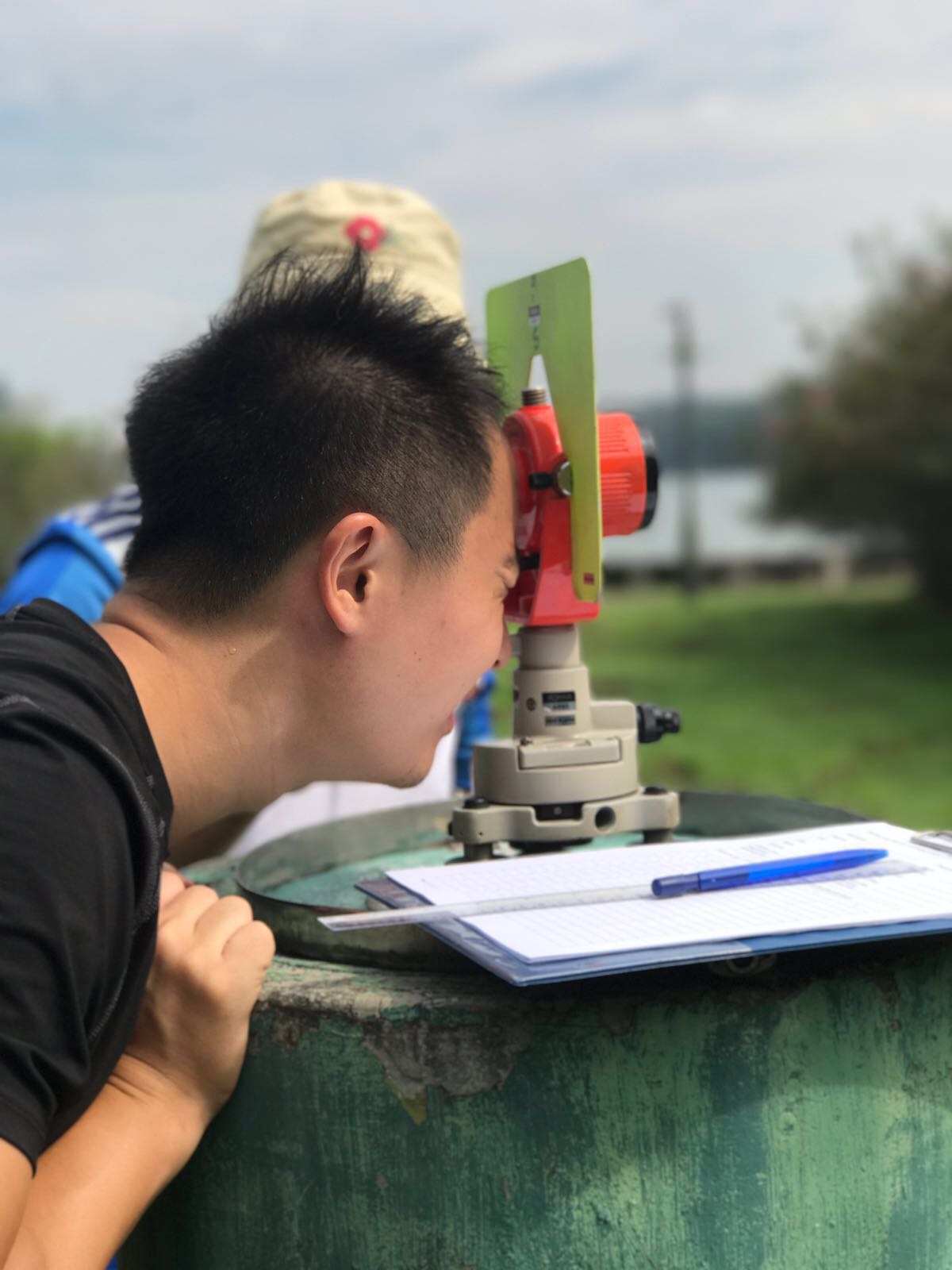
From Wikipedia (https://en.wikipedia.org/wiki/Total_station): In surveying, a prism is... normally attached on a surveying pole, used as a target for distance measurement using, for example, a total station. ... used for surveying and building construction...  to measure both vertical and horizontal angles and the slope distance from the instrument to a particular point, and an on-board computer to collect data and perform triangulation calculations.

This monitoring prism... is a 3-dimensional triple mini prism target primarily used for measuring the deflection of buildings.

Example of land surveying in action.

NParks have a similar device, but don't work in the same way though.

Sunday, December 2, 2018

Khaya senegalensis Trunk Collar and Root Rot

Khaya senegalensis or Senegal Mahogany (Family: Meliaceae) is regularly seen along the roadside of Singapore's roads. I would say that new plantings of K. senegalensis by the National Parks Board stopped by around 2010. To digress, I have not seen new plantings of another Mahogany, Swietenia macrophylla (Honduras Mahogany) since... ever. And to digress further, those two are introduced species and the only native Mahogany species that I know of are Xylocarpus rumphii, X. moluccensis and X. granatum, which are coastal/rocky beach or back mangrove trees.

Decay caused by fungus in the trunk collar and root (also called Charcoal stump rot) was observed in K. senegalensis in Singapore since the 1980s. Although the disease could spread across a whole stretch of trees, it does not seem to be as devestating as the Fusarium Wilt Disease in Angsana. Infected K. senegalensis would decline slowly over a period of 1 to 2 years. One of the signs of the causal fungi, Kretzschmaria zonata (synonym: Ustulina zonata) is inconspicuous fruiting bodies on the surface roots.

Symptoms are as follows:
  • Trees are first noted to be partially defoliated. With each new growth, the leaves are smaller and of lighter green showing progressive decline over the years.
  • At the tree collar under the cracked bark, wood tissue is discoloured which signifies decay. White fungal growth may be noted under the bark fanning out over the collar area.
  • Tar patches are noted on diseased roots which also show a network of black mycelia over the decayed wood. The tar patches are the initiation of the fungal fruiting bodies. These are low lying crusty carbonaceous layars varying in size 5-20mm thick, buried in the soil and often unnoticed among the cover of grass. Fungal spores are present in chambers within the black lumps.
  • The pathogen penetrates deep into the centre of large trees causing a heart wood rot, turning them to dry brittle wood. Such decay can lead to unsuspected tree failure.
  • Disease spread to near by K. senegalensis along the tree row via root contact with diseased roots and fruiting bodies.

What to do:
  • Remove diseased trees including excavation of the entire stump and as much of the roots as possible for incineration. Also search and remove all black fruiting bodies from the infected area.
  • Plant holes may be fumigated to rid the fungi before planting.
  • Alternatively fungicide drenches with benomyl or thiophanate-methyl may be applied as preventive measures to protect surrounding "healthy" trees.


Reference - The Singapore Plant Health Guide by the Agri-Food & Veterinary Authority of Singapore

K. senegalensis wood colour ranges from a very pale pink to a deeper reddish brown. Color tends to darken with age. Shown here with the wood of other tree species stacked on top.

 Even large wounds close up completely very relatively fast. Nice dome shape.

 Maybe I was pre-condition to spot the "trunk collar and root rot" but this wound wood roll does seem to be discoloured.

 But tree does not seem to exhibit partial defoliation or dieback, so it should be alright.

Tuesday, October 30, 2018

South Korea Tree Planting Day and Beach Road


One photo, so many comments. I got an inkling where our public service received their unique traits from.

 Near Textile Centre. I was sure this tree climber was not tethered to anything.