Monday, December 3, 2018

Tanjong Pagar Railway Station - Restoration and Preservation

Tanjong Pagar Railway Station (former) was closed in Dec 2016 and works were carried out to cut the platform canopies (?) and locate them to a holding area, while the new underground Cantonment MRT station would be constructed as part of the Circle Line extension. The historic building would be linked to the new MRT station when it will be completed in 2025.

The prominent facade statues carved in what seemed to be Soviet style.

When you tell people not to do it...

Platform canopies with fascia fins, which are unique grooves on their eaves. These seemed to have been jet-washed before, maybe to test how well they hold up.

 Another look at the platform canopies.


A heritage Raintree seemed to be close to the Cantonment MRT station construction works.

  "KEEP OUT - Heritage Tree Protection Zone"

PVC tubes capped and buried in the ground, and encased with concrete, located behind the tree and there was a similar one downslope in front of the tree. I believe that there are inclinometers inside those PVC tubes.

 Raintree was attached with monitoring prisms for surveying/surveillance.

From Wikipedia (https://en.wikipedia.org/wiki/Total_station): In surveying, a prism is... normally attached on a surveying pole, used as a target for distance measurement using, for example, a total station. ... used for surveying and building construction...  to measure both vertical and horizontal angles and the slope distance from the instrument to a particular point, and an on-board computer to collect data and perform triangulation calculations.

This monitoring prism... is a 3-dimensional triple mini prism target primarily used for measuring the deflection of buildings.

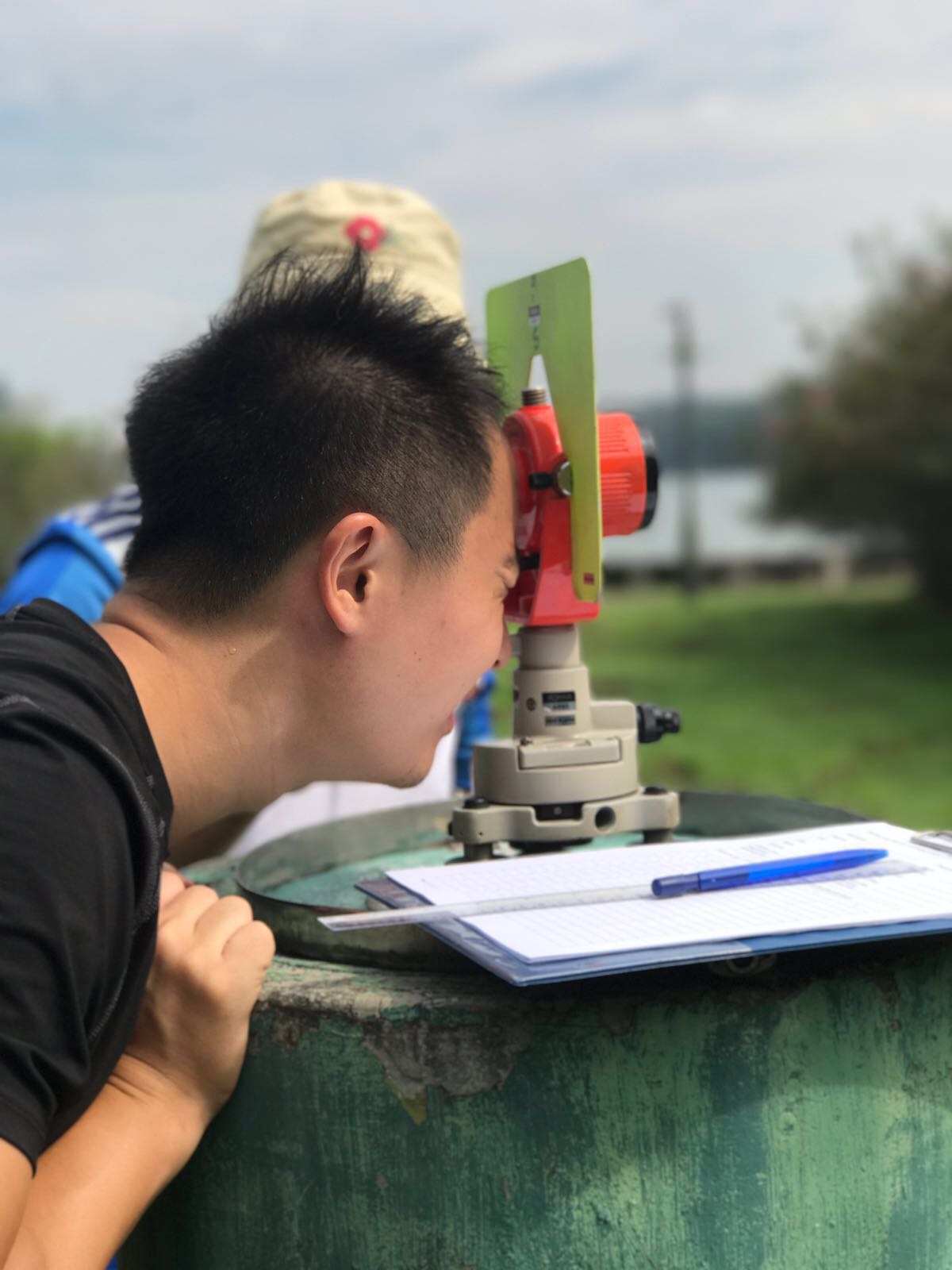
Example of land surveying in action.

NParks have a similar device, but don't work in the same way though.

Sunday, December 2, 2018

Khaya senegalensis Trunk Collar and Root Rot

Khaya senegalensis or Senegal Mahogany (Family: Meliaceae) is regularly seen along the roadside of Singapore's roads. I would say that new plantings of K. senegalensis by the National Parks Board stopped by around 2010. To digress, I have not seen new plantings of another Mahogany, Swietenia macrophylla (Honduras Mahogany) since... ever. And to digress further, those two are introduced species and the only native Mahogany species that I know of are Xylocarpus rumphii, X. moluccensis and X. granatum, which are coastal/rocky beach or back mangrove trees.

Decay caused by fungus in the trunk collar and root (also called Charcoal stump rot) was observed in K. senegalensis in Singapore since the 1980s. Although the disease could spread across a whole stretch of trees, it does not seem to be as devestating as the Fusarium Wilt Disease in Angsana. Infected K. senegalensis would decline slowly over a period of 1 to 2 years. One of the signs of the causal fungi, Kretzschmaria zonata (synonym: Ustulina zonata) is inconspicuous fruiting bodies on the surface roots.

Symptoms are as follows:
  • Trees are first noted to be partially defoliated. With each new growth, the leaves are smaller and of lighter green showing progressive decline over the years.
  • At the tree collar under the cracked bark, wood tissue is discoloured which signifies decay. White fungal growth may be noted under the bark fanning out over the collar area.
  • Tar patches are noted on diseased roots which also show a network of black mycelia over the decayed wood. The tar patches are the initiation of the fungal fruiting bodies. These are low lying crusty carbonaceous layars varying in size 5-20mm thick, buried in the soil and often unnoticed among the cover of grass. Fungal spores are present in chambers within the black lumps.
  • The pathogen penetrates deep into the centre of large trees causing a heart wood rot, turning them to dry brittle wood. Such decay can lead to unsuspected tree failure.
  • Disease spread to near by K. senegalensis along the tree row via root contact with diseased roots and fruiting bodies.

What to do:
  • Remove diseased trees including excavation of the entire stump and as much of the roots as possible for incineration. Also search and remove all black fruiting bodies from the infected area.
  • Plant holes may be fumigated to rid the fungi before planting.
  • Alternatively fungicide drenches with benomyl or thiophanate-methyl may be applied as preventive measures to protect surrounding "healthy" trees.


Reference - The Singapore Plant Health Guide by the Agri-Food & Veterinary Authority of Singapore

K. senegalensis wood colour ranges from a very pale pink to a deeper reddish brown. Color tends to darken with age. Shown here with the wood of other tree species stacked on top.

 Even large wounds close up completely very relatively fast. Nice dome shape.

 Maybe I was pre-condition to spot the "trunk collar and root rot" but this wound wood roll does seem to be discoloured.

 But tree does not seem to exhibit partial defoliation or dieback, so it should be alright.

Tuesday, October 30, 2018

South Korea Tree Planting Day and Beach Road


One photo, so many comments. I got an inkling where our public service received their unique traits from.

 Near Textile Centre. I was sure this tree climber was not tethered to anything.

Saturday, July 28, 2018

The Geocarto International Centre in Hong Kong wrote an article in the Aug 2018 Arborist News ("An Integrated Approach to Tree Stress Monitoring"), as a follow-up to the article they published in Apr 2017 ("A New Technology Warns of Stressed Trees").

I wrote a summary on the Apr 2017 article here: http://openplants.blogspot.com/2017/05/monitoring-at-risk-trees-using-spectral.html

In the Aug 2018 article, as mentioned before, the spectral reflectance data were collected from satellites to observe the following in trees:
  • Drop in near-infrared band
  • Drop/shift in red-edge band
  • Rise in red band, which means a drop in chlorophyll absorption
So, how much drop or rise would warrent concern about the tree's health? The article went on to show the spectral reflectance curves in different trees collected within a 4 to 6 years period. Keywords here being "retrospective study" [emphasis mine], as the author would mention later.

 Arborist News, Aug 2018, page 29

Arborist News, Aug 2018, page 30

The author highlighted a case where a 400 years old Ficus benjamina in Kowloon Park, Hong Kong deteriorated due to park redevelopment, branch failure due to typhoon and brown root rot. A treatment of Trichoderma was applied presumably after Sep 2013 when its removal was withdrawn. The spectral reflectance chart below reflected the claim that the tree improved in its health.

Arborist News, Aug 2018, page 31

 According to this chart:
  • Rise in near-infrared band <- Indicates better leaf cellular structure
  • Rise and fall in red-edge band <- Indicates rise in chlorophyll absorption in 2011, dropped in the subsequent years (coincide with application of Trichoderma) and rised again in 2017
  • Not much difference in red band <- Indicates no difference in chlorophyll absorption
In my opinion, the chart does not indicate that the Trichoderma treatment has definitely suppressed the brown rot fungus. And while the tree's physiological health seemed to be improving, it structural condition is uncertain due to the redevelopment, wind-throw (typhoon), and anything prior to its decline.

Sunday, July 22, 2018

Gardens by the Bay, Flower Dome

Flower Dome in Gardens by the Bay opened in November 2011 to the public. South American, South African, Australian plants. Mediterranean cool and relatively lower in humidity. Chilean Wine Palms or Jubaea chilensis are from the South American nation of Chile. Overpruning of fronds and/or nutrient decifiency affects the trunk's taper; causing it to develop a bottleneck trunk, which is also known as "penciling". The narrower trunk could lead to fracturing. Makes fronds smaller and skinnier. Been 6, 7 years since the palms arrived in Singapore and they still have not overcame the penciling issue.

From the Palm Tree Doctor blog:
In addition to preventing malnutrition, proper maintenance fertilization provides the following benefits:
  • More cost effective to keep palms healthy than replace
  • Greatly increased size and fullness of the canopy
  • Allows each frond to stay greener longer
  • Allows self-cleaning palms to drop their dead fronds more rapidly
  • Improves ability to survive hurricane force winds
  • Accelerates recovery after storm damage
  • Increases cold hardiness

 Penciling palms in differing severity. One in the background was in its death throes.

In order to harvest the sap to make wine, the whole palm have cut down, hence the name. Extremely slow-growing, making large specimens like these a rarity.

 A slightly narrow trunk would represent leaner days, quite usual for single trunk palms of larger girth - whether in the wild, nursery-grown or planted in the landscape.

I think this was the one in the middle of the Chilean wine palms' group photo. Has smaller and narrower fronds.

Tuesday, June 26, 2018

Free Plant with a bag of potting mix

I got some "weed" seeds from my bag of potting mix.


 This "free" plant grew out from that potting mix.

The venation almost seemed to glow.

Sunday, May 6, 2018

Hopea sangal - a series of events across 2 years

In Sep 2002, a Hopea sangal re-discovered in Changi, which was significant as it was thought to be extinct in in the Singapore Red Data Book, and the name Changi was thought to have been originated from the tree's common name, Chengal Pasir.

Hopea sangal at Changi.
Photo credit: Tan Beng Chiak

However, the property management company taking care of the area felled the tree without the approval from authorities in November in the same year. The company's manager observed that the tree was struck by lightning and was not doing well, and decided to have the tree removed. Sivasothi who was there to check out the re-discovery was just in time to witness the felled logs from the tree being hauled away.

Hopea sangal stump.
Photo credit: Sivasothi

Logs being hauled away.
Photo credit: Sivasothi

The logs were recovered and artists carved pieces of the wood into sculptures. Some of the sculptures were exhibited at the Singapore Zoo main entrance.


Before the tree was felled, some seeds were collected by Nature Society Singapore's (NSS) members and passed to National Parks Board for propagation. After about two years of being "grown partially in a carbon dioxide enriched chamber", the sapling was more than one metre in height. Some seeds were grown by the NSS and a sapling was handed to the Singpore Zoo.

On 7 Nov 2004, Mr Lee Kuan Yew planted a sapling nurtured by NParks Pasir Panjang Nursery at Henderson Crescent, between Blocks 103 and 104.

Mr Lee planting the Hopea sangal sapling while members of parliament (MP) of the Tanjong Pagar group representation constituency (GRC) and community members look on.
Photo credit: John Yong

Google map showing approximate location of the VIP-planted tree (in red pointer).
Block numbers added by me.
Map credit: Google Maps.

I tried to locate the tree and it was found at a not so prominent spot (pointed by red arrow). 
Photo taken by me on 6 May 2018.

Overall view of the tree - the crown facing the west seemed more lush than the part facing the east, probably due to a block to the east (block 106). Note the surrounding trees that are topped.
Photo taken by me on 6 May 2018.

The tree is leaning to the north, possibly due to the phototropism as there is a block to the south (block 104) and palms (Dypsis lutescens) fighting for crown space. It is also slightly assymmetrical, as the crown is raised higher at the part where it is in contact with the palm leaves.
Photo taken by me on 6 May 2018.

Girdling root to the south of the tree.
Photo taken by me on 6 May 2018.
The plaque reads:
"Tanjong Pagar Town Council
Clean and Green Week 2004
This tree, Hopea sangal was planted by Mr Lee Kuan Yew
Minister Mentor and MP for Tanjong Pagar GRC
on 7 November 2004"
Photo taken by me on 6 May 2018.