Friday, September 16, 2016

Storm-Vulnerable Trees

The Tree Management Programme of the National Parks Board (NParks) describes the inspection of trees "along major roads or  areas with high human activity" at least once every 12 months. Crown reduction  pruning was conducted when necessary. [1]

Furthermore, NParks was on an exercise to remove/replace storm-vulnerable trees and advising other public agencies, such as the Singapore Land Authority (SLA) and Housing and Development Board (HDB), to do the same. The only storm-vulnerable species publicised was the Albizia tree (Falcataria moluccana), which is fast-growing and could easily exceed 20m in height. But its wood is soft and prone to breaking during storms. In addition, they are shallow-rooted and thus susceptible to uprooting. There should be other storm-vulnerable species listed, but unfortunately, they were not shared in the article.

Photo by Shin Min Daily News

Almost 4 years ago (27 Sep 2012), a NSman on in-camp training was crushed by a tree and was subsequently pronounced dead at the hospital he was taken to [2]. The incident took place at the entrance of the Ama Keng Training Area in Lim Chu Kang. If a certified arborist (CA) were to have carried out tree inspection on that tree, the CA could have recommended the removal of the offending tree. Based on the photo, the tree appeared to be an African tulip tree (Spathodea campanulata), detailed further below.

In an "after" photo where SLA selectively removed Albizia trees at Jalan Anak Bukit, (near Bukit Timah Hill), African tulip trees were observed to be left behind and intact. [1] The site of the "after" photo was visited last week and it looked very different due to road expansion works.

 "After" photo after an exercise by SLA to remove Albizia trees. Probably taken in 2012, from NParks website [1].


 Road widening in the target area of storm-vulnerable trees, which include Albizia and African Tulip trees. Photo taken on 11 Sep 2016.
African tulip trees near the edge of the road expansion.

Land Transport Authority (LTA) notice on the road widening.

There are nine tree species identified as being invasive in Singapore. A common attribute of these invasive tree species is that as compared with non-invasive species, they have only 54% of the mean wood density. It should be noted that other than Falcataria moluccana and some outlying individuals of Cecropia pachystachya, "no attempt has been made to control the other species." [3]

The following are four of the invasive tree species that could be considered "storm-vulnerable", which could be removed from roadsides, forest edges, parks and high-traffic areas:

a. Acacia auriculiformis (Ear-leaf acacia)
It could grow in nutrient poor soil as it has nitrogen-fixing bacteria associated with its roots. Fast-growing and drops a lot of leaves. Roots grow shallow, spreading and densely matted, which makes it suitable to stabilise eroding land.

b. Cecropia pachystachya (syn. Cecropia peltata) (Trumpet tree)
In Singapore, this tree is viewed as a weed and is short-lived [4]. It has hollow stems, which is inhabitaed by ants.

c. Falcataria moluccana (Moluccan albizia)
Perhaps the fastest-growing tree in the world [4]. Like the Acacia, it is capable of fixing nitrogen from the air. Considered a weed and hazard due to its soft, brittle wood, and shallow roots.

d. Spathodea campanulata (African tulip tree)
Similar to the Albizia tree, the wood of the African tulip tree is soft, tends to become hollow, and drops their branches over time. The roots grow shallow and is more likely to uproot during storms.

Table 1. Invasive tree species in Singapore with their common names
Acacia auriculiformis    Ear-leaf acacia
Cecropia pachystachya    Trumpet tree
Falcataria moluccana    Moluccan albizia
Leucaena leucocephala    Lead tree
Manihot carthaginensis    Ceara rubber tree
Muntingia calabura    Jamaican cherry tree
Piper aduncum    Spiked pepper
Spathodea campanulata    African tulip tree

Table 2. Potentially invasive tree species (not necessarily storm-vulnerable) identified in the paper [3]
Hevea brasiliensis    Para rubber tree
Andira inermis    Brown heart tree
Ptychosperma macarthurii    Macarthur palm
Elaeis guineensis    Oil palm
Ficus religiosa    Bodhi tree

Reference:
1. National Parks Board Tree Management Programme (https://www.nparks.gov.sg/news/2013/1/nparks-tree-management-programme), 1 Jan 2013, Last updated on 20 Nov 2014,
2. Jalelah Abu Baker and Lim Yan Liang, NSman's death: Tree was checked in April, Asiaone (http://news.asiaone.com/News/Latest+News/Singapore/Story/A1Story20120929-374484.html), 29 Sep 2012
3. Nghiem, L. T. P., Tan, H. T. W. and Corlett, R. T. 2015. Invasive trees in Singapore: are they a threat to native forests? Tropical Conservation Science Vol.8 (1): 201-214
4. Tee et. al., Trees of Our Garden City, 2nd ed, 2009

The man behind the design of Seiwaen (Singapore's Japanese Garden)


Kinsaku Nakane on the left with his son Shiro on the right.

Seiwaen opened on 16 Feb 1973, the largest Japanese garden outside of Japan at that time. The garden was built on a man-made island in the middle of Jurong Lake, adjacent to Yu Hwa Yuan (Chinese Garden). Designed by Professor Kinsaku Nakane, Japan's leading landscape designer, the garden took four years to complete. Originally part of a swamp, the Chinese and Japanese Gardens are two of three man-made islands at Jurong  (the third one being Jurong Country Club... which is more of like an extension rather than an island).

This large strolling garden was constructed according to the gardening techniques that prevailed from the Muromachi Period (1392 - 1568) to the Momoyama Period (1568 - 1615). The architecture was based on post-war style.

Funding came from Singapore and Japanese governments as well as the local Japanese organisations at the cost of $3 million. The garden symbolises the peace and prosperity between Singapore and Japan. Notable landmarks are the 4 metres (13-foot) tall Kasuga stone lantern that overlooks a lake and Torii gates at the "guesthouse" building.

The garden was closed since 2001 and in 2003, after a review, closed for renovations and reopened on 15 July 2007. As part of the effort to re-invent itself, large amount of earth was brought in to terra-form the land; artificial hills were created.

Nakane passed away at the age of 77 on 1 March 1995 in Kyoto. Apart from designing gardens in Japan, China and in the West, he was the President of the Osaka University of Fine Arts and Nakane Garden Research, which is still in operation today with his son Shiro at the helm. [URL: http://www.lares.dti.ne.jp/~nakane/index.html]

The Tenshinen ('Garden of the Heart of Heaven") at the I.M. Pei West Wing, Museum of Fine Arts, Boston, USA, which was completed in 1987 was his most prominent work. Reminiscent of the gardens in the shogun estates of the Edo period (1603-1867), the Tenshinen incorporates symbolic details of the New England landscape (rocky coastline and deep forests) over which Nakane flew in a helicopter when he was formulating his garden plan. The Japanese garden at Jimmy Carter Library and Conference Center in Atlanta, Georgia, was also designed by him.

The Tenshinen was re-opened on April 2015 after a year-long effort to restore the garden, and documented by the Nippon Television Network Corporation. In the course of the renewal, new plants, paving, irrigation, drainage, lighting, and granite gravel were installed.

In Toowoomba, Queensland, Australia, the Ju Raku En is a Japanese garden designed by Nakane with construction starting on 1983 and opened in April 1989. The 4.5 hectare garden is jointly own by University of Southern Queensland and the Toowoomba City Council, and is Australia's largest Japanese garden. It is located at the northern side of the campus.

Sources:
1. Elizabeth Ten Grotenhuis, The Journal of Garden History, pp. 231-232, 30 Apr 2012)
2. Museum of Fine Arts, Boston, http://www.mfa.org/collections/featured-galleries/japanese-garden-tenshin-en

Friday, September 2, 2016

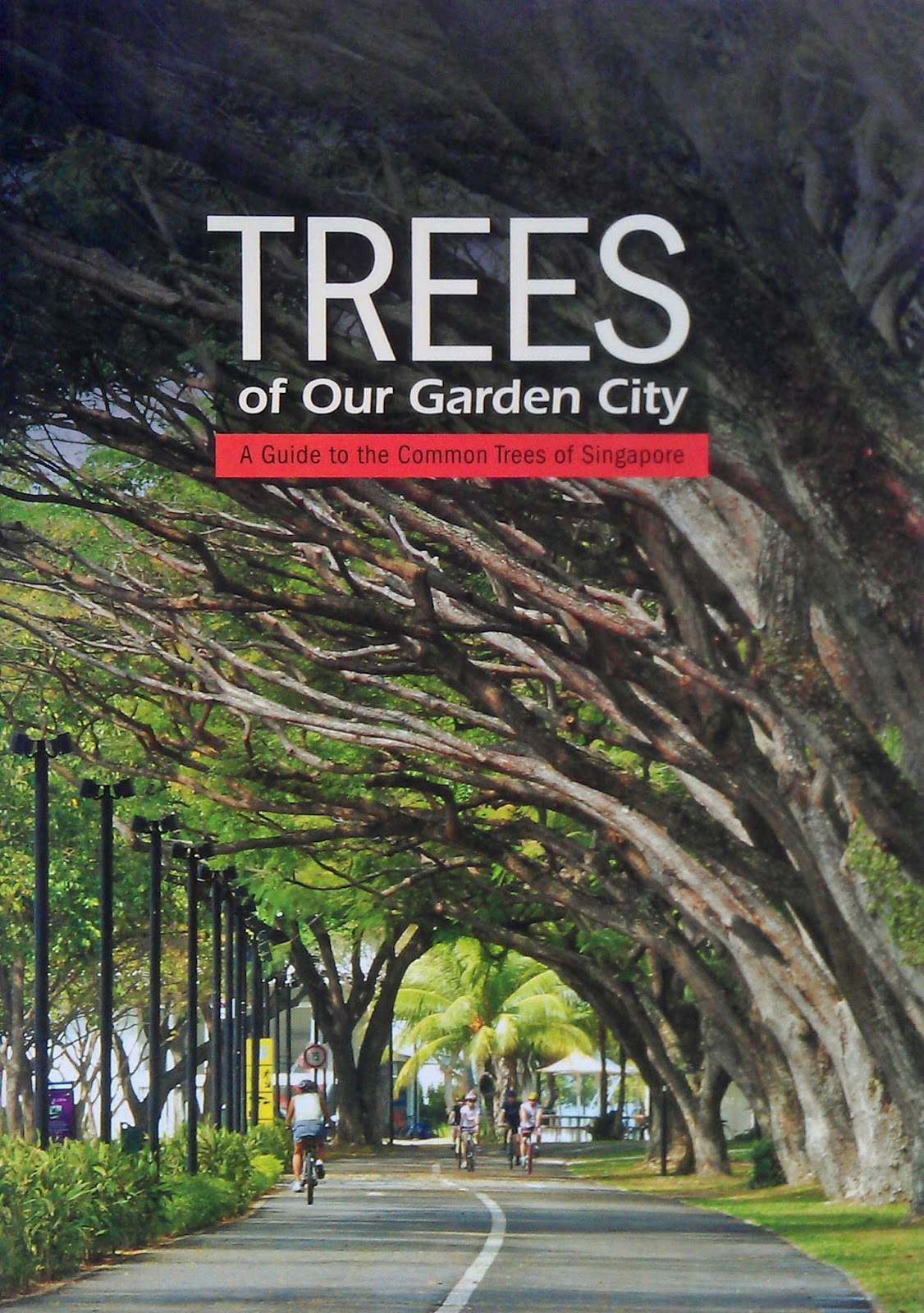
Trees of Our Garden City: A Guide to the Common Trees of Singapore


Publisher: National Parks Board, Singapore
First published: 2001, Second ed: 2009
Authors: Tee Swee Ping et al. (see more below)
Pages: 210 pages
Showcasing 132 trees and 18 palms species

Chapter Headings:
Foreword
Introduction
Chapter 1 - Our Garden City Story
Chapter 2 - Tree and Palm Species
Chapter 3 - Tree Biology
Chapter 4 - Tree Care (Tree Planting, Tree Planting Distance, Tree Inspection, Tree Pruning, Pests and Diseases of Trees, Conservation of Urban Trees)
Chapter 5 - Growing Trees in Rooftop Gardens
Chapter 6 - Trees and the Environment
Glossary
Bibliography
Index (by Botanical names, by Common names, by Chinese names)
Acknowledgements


Editorial Committee:
Tee Swee Ping
Yong Wei Kwong
Ms Jerrie Ng Sy Chi
Ms Germaine Ong Zi Ming

Writers & Contributors:
Dr Chin See Chung, Dr Tan Puay Yok, Dr Benito Tan, Dr Nura binte Abdul Karim, Dr Lim-Ho Chee Len, Dr Lena Chan, Dr Fong Yok King, Ang Chee Wee, Ali Ibrahim, Abdul Hamid bin Mohd, Chan Chun Leong, Derek Chan Yeow Kwang, Low Yong Kwee, Eric Ong Yongquan, Hassan Ibrahim, Ms Kalthom Abdul Latif, Lahiru Suranga Wijedasa, Lee Jia Hwa, Lim Choon Boon, Ms Lily Chen Mei Jun, Lua Hock Keong, Muhamad Shahrizal Sihab, R Mathichandran, Ms Patricia Yap Siew Yen, S K Ganesan, Simon Longman, Sim Eng Koon, Tan Chin Peng, Ms Thereis Choo Yi Siang, Toh Chin Heng, Voon Chin Seng, Ms Lee Pin Pin, Ms Germaine Ong Zi Ming, Ms Mitina Tan, Ms Melanie Wee Mei Choo, Ms Chan Yang Sun, Yong Wei Kwong, Ms Jerrie Ng Sy Chi, Tee Swee Ping.

Photos Credits:
Chan Chun Leong, Lee Jia Hwa, Ms Patricia Yap Siew Yen, Lin Yangchen, Paul Leong, Ms Lily Chen Mei Jun, Choy Heng Wah, Gary Chua Liat Seng, Benjamin Lee Yi-Hann, Mervin Quah, Ms Eleanor Soh, S K Ganesan, Wong Tuan Wah, Dr Yam Tim Ying, Tee Swee Ping.

Tree Conservation Area (TCA)

Tree Conservation Areas have mature trees that enhance the environment with their lush greenery and shade. It was established in Singapore to control careless felling of those trees.


Protected trees are defined as:
  • More than 1m girth (or 0.31m diameter)
  • Heritage trees and roads (could be outside TCA)
  • Within vacant land

Trees could be protected whether on State and privately owned land. They cannot be felled without approval from National Parks Board (NParks).

Failure to do so:
  • Compensation (when case taken to court; determined by prosecution. between $76,000 and $50,000 based on past cases) and fine of not more than $50,000, or
  • Composition fine of $2,000 for each tree felled [1]

A Certified Arborist report may be needed to accompany the request to NParks.
Depending on tree species, size and condition, a basic assessment report costs $150-$600 per tree.

To check if your land is on TCA and for reports to accompany your submission, contact a Certified Arborist (not from NParks) from this list:
http://www.cuge.com.sg/Listing-of-Certified-Arborists


Reference:
1. http://wildsingaporenews.blogspot.hk/2009/07/house-owner-fined-6000-for-cutting-down.html
2. https://www.nparks.gov.sg/gardens-parks-and-nature/tree-conservation-areas

 TCA 1

TCA 2

Detection Tools for Advanced Tree Assessment (with Prices)

1. Cordless drill with a small-diameter bit (Bosch drill GSR 18V Li-Ion)
USD $300

2. IML-RESI MD300 (including Bosch drill GSR 18V Li-Ion)
USD $1,600
 
3. IML-RESI PD300
USD $7,400

4.  Rinntech R650-ED
USD $7,800

5. PiCUS Sonic Tomograph with 10 sensors
USD $20,000

6. Tree Radar Model TRU-900 (without wheel cart)
USD $32,000

A summary of the prices. A higher price does not equate to better detection and charting of tree decay.


Saturday, August 27, 2016

Signing off with credentials - on Certifications and Qualifications


Recently, having to provide some details in order to have my business card printed and coming across the above made me wonder on what credentials should practitioners in the green industry sign off with and under what circumstances. The office administrator advised me not to include memberships but qualifications like degrees. I would explore some of them that I come across below. An often mentioned acronym is "ISA", which refers to The International Society of Arboriculture an international non-profit organization headquartered in USA. Its mission statement: "Through research, technology, and education promote the professional practice of arboriculture and foster a greater public awareness of the benefits of trees." The organisation has more than 22,000 members (from Wikipedia), from all over the world with the exception of Middle East and Africa.

In general, certifications could be verified with their accreditation bodies using the Cert. ID or number of an individual. However, qualifications does not come with a Cert. ID.

Principal/Practising/Lead/Consulting/Staff Arborist
Usually someone who practices as an arborist in the tree/arboriculture industry but just about anyone can call themselves the above as there is no accreditation body to govern the use of those titles.

Certified Arborist
The ISA certifies an individual's knowledge in arboriculture and hence such an individual may name themselves a Certified Arborist (CA). The Certified Arborist programme refreshes learners with skills for tree inspection and knowledge to mitigate potential failure. To qualify for the programme, a candidate must have the one of the following

Education    Practical experience
4 years honours degree in Arboriculture or equivalent    1 year
3 years degree in Arboriculture or equivalent    2 years
2 years degree in Arboriculture or equivalent    2 years
Diploma in arboriculture or equivalent    2 years
No qualification    3 years

The programme is 80 hours of training over 11 days. The course is facilitated by CUGE (a division under National Parks Board), which is a CET institute conferred by Workforce Development Authority (WDA).

The certification would last for 3 years, and in order to be re-certified, the CA have to undergo courses/workshops/seminars to accumulate Continuing Education Units (CEUs) of 30 points by the end of the 3 years period. Some seminars that is an hour to half a day may give 1 point, whereas some courses that runs over 3 days may give 10 points. The arborist may also purchase books and undertake online course from the ISA website to gain CEUs. These avenues from which to acquire CEU points are often not free.

There are close to 500 CAs in Singapore at the time of writing, roughly half of which are in National Parks Board, other government institutes, and government-linked companies.

Tree Risk Assessment Qualification (TRAQ)/ Tree Risk Assessor
Appliants to this programme must be a Certified Arborist, amongst many other arboriculture certifications. The course would impart to candidates a process and techniques for the assessment of tree risk over 2 days of training and half day assessment.

This qualification lasts for 5 years and could only be renewed by going through the course again and passing the assessment. CEUs points earned could not go towards the renewal of this qualification, but certified arborist would be awarded 14 CEUs for attending this course.

There are 84 TRAQ holders as at the time of writing, 24 of which are not of NParks.

Certified Arborist/Municipal Specialist qualification
In order to qualify for the Municipal Specialist qualification, the applicant have to a Certified Arborist in the first place. The programme focuses on 6 domains as follows: communication skills, public relations, administration, risk management, arboricultural practices, and policy planning in a municipal setting. However, this qualification seemed to have to advantage for private industry players but more suitable for public servants. A municipality may encompass a "city, town or village" but the term is not used in Singapore.

This qualification lasts for 3 years and could be renewed by gaining 42 CEU points over that 3 years or retaking the exam. Of the 42 CEU points, 30 CEUs are for the CA credential, and 12 CEUs are for the Muicipal Specialist qualification.

As at the time of writing, there are 24 CA/Municipal Specialists, of which only 3 are in the private sector.

Board Certified Master Arborist
This is the highest level of certification in arboriculture offered by the ISA. The exam covers every aspect of arboriculture other than consulting, in the 19 domains as follows.
SCIENCE: Abiotic, biotic influences. Biology and ecology. Diagnostic process and tools. Plant taxonomy and attributes. Soil science.
PRACTICE: Tree climbing techniques and equipment. Plant health care. Water management. Pruning techniques. Fertiliser, pesticide and other biological treatments. Support, guying and lightning protection.
MANAGEMENT: Business relation and operations. Inventory and management plan. Risk assessment and mitigation. Safety practices, tools and equipment. Tree protection guidelines and migitation.

Pre-requisite for entry into the programme depends on a points system, to be obtained by being accredited/certified with the ISA certification program, having tertiary education in arboriculture or related fields, and other arborist credentials. This certification is valid for 3 years and could be renewed by accumulating 60 CEU points that are related to the 19 domains in the exam.

There is only 1 BCMA in Singapore as at the time of writing. Among all ISA Certified Arborists (worldwide), less than 2 percent are BCMA, which is more than the 0.2 percent in Singapore.

Certified Practising Horticulturist

To qualify for the Certified Practising Horticulturist programme, the candidate would need to have a degree or diploma in horticulture or a related discipline, or WSQ diploma or advanced certificate in Parks Reserves and Gardens. And with at least 5 years of relevant working experience in the industry.

The programme consists of 13 days training and if successful with the assessment and report submission, candidates would be registered as Certified Practising Horticulturist accredited with the Australian Institute of Horticulture. The certification is valid for 3 years and during which the CPH have to undergo courses/workshops/seminars to accumulate Continuing Education Units (CEUs) of 30 points, in order to be re-certified.

In addition to courses/workshops/seminars, CEUs for CPH may also be earned through studying in a tertiary programme, study tours, lecturing/teaching, presenting/submission of papers, committee work and reading.

There are close to 200 CPH in Singapore at the time of writing.

Certified Parks Manager
The Certified Parks Manager programme seemed to be suspended as there is no new runs since 2015. CPM are accredited with the Parks and Leisure Australia (PLA) and the programme seeks to refresh park managers' knowledge in park management and planning, share best practices in park operations and confer skills in communication with the public and media. The training takes place over 15 days and half day for exam and report submission, which is a minimum 2000-word Park Operations Report.

In Singapore there are over 100 members, of which about a quarter are not NParks personnel, as at the time of writing. In addition, this certification does not come with a Cert. number, and hence one could not verify if an individual holds this credential. However, the Centre for Urban Greenery and Ecology (CUGE) website holds a record of CPM in Singapore.

ISA Local Chapters and associate organisations

Local chapters and associate organisations are like industry groups that is focused on the local context, and they serve as a platform to exchange knowledge, skills and ideas, and sometimes organise regional tree climbing competitions.

The Singapore Arboriculture Society (SAS) is such an associate organisation. They have 57 Certified Arborists on board as of year 2014, which is slightly over 15 percent of CAs in Singapore (and incidentally a member count that could see them convert to a Local Chapter). Membership with the SAS could be subscribed at $20-80 depending on the type. Only "professional members" could vote during annual general meetings (AGM). The latest iteration of the tree climbing competition is the "Singapore Tree Climbing Championships (STCC)" to be held on 22-24 September 2016.

They publish an e-magazine named TropicalArb, with the first issue on July 2013 and second issue on May 2014. The third issue is not forthcoming as of Aug 2016.

Being ISA certified does not mean being an ISA member. Being a member of the local chapter or associate organization, and an ISA member (the international organisation as opposed to the local one) and would entitle one to receive a discount on recertification fees, however membership is not free. In this sense, membership subscription functions more like a discount or loyalty scheme. Being an ISA member would entitle one to purchase books and courses at a discount.

Sunday, October 18, 2015

Fruiting bodies at root collar

In what seemed like going to be a series of entries on fruiting bodies appearing at the base of trees (previous entry), here is another occurrence! I neglected to mention earlier, but trees that are affected by ganoderma would show symptoms of weak aboveground parts (e.g., yellow and falling leaves, poor growth, etc). Having spotted fruiting bodies peeking out from the base of a palm, I would expect to see yellowing fronds, but...

Fruiting bodies appearing from the mass roots stubs at the trunk base.

The palm (Roystonea oleracea), which is situated in a park seemed healthy enough.

What a red herring. The fungi was probably using some organic matter trapped in the mass of root stubs as a substrate, without penetrating the palm trunk.

In our next case study, a tree, which was also situated in a park, was obviously not doing well, and had a fruiting body protruding from a wound (one feet long from ground up). Maybe the wound made the inoculation of the fungi easier as opposed to if there was no wound. It was decided to have the tree removed, as it posed a risk to the people passing by on the path right beside the tree.

 Not a red herring this time

 Cratoxylum formosum. You can notice the mushroom spanning across more than half the trunk girth.

The red arrow indicates the side of the trunk where the fruiting body appeared. It is noted that the ganoderma had broken down the heartwood. As a white-rot fungi, it had decayed the sapwood turning it white. Although more than half of the tree base had been ebbed away, research had found that significant strength loss (leading to tree failure) would occur in late stages of decay.