Monday, March 29, 2021

Excerpt of "Managing Soil Compaction Around Trees"

Generally, soil compaction is found at the top 30cm of the soil, which coincides with the region where most roots grow. Where possible, soil compaction should be prevented to maintain an environment suitable for root development.

Soil strength is measured by a penetrometer which measure force required for a probe to push into the soil. Penetrometer readings in excess of 2 MPa (2 megapascals = 20 bars) will restrict root elongation. As bulk density increase, soil strength is more likely to increase in step, and even more likely in drier soil than wetter conditions. Most roots are unable to penetrate moist soils of a bulk density > 1.4-1.6g cm-3 in high clay soil and 1.7g cm-3 in more sandy soil. 

Low pore space is harmful to roots and microorganisms as it would lead to hypoxic (low oxygen) conditions and reduced nutrient uptake. Tree nutrient deficiency would result even if nutrient level is good. Compacted soil can lead to both water deficiency and water logging. Erosion due to compacted surface will increase nutrient leaching and remove topsoil, which decrease tree stability.

In a classic case of a tree growing in compacted soil, a decline of the crown can be observed. In consideration of existing and newly planted trees, soil should be prevented from compaction by means of physical barriers or routing paths away from rooting zones.

Decompaction - Before trees are planted, the site could be cultivated using hand tools or equipment. As for de-compaction an area with existing trees, the best method to use air soil-excavation tools. They can facture compacted soil to around 30 cm depth and minimise disturbance to roots.


Reference:

1. International Society of Arboriculture's Arborist News, Volume 29, Number 5, October 2020

Sunday, October 18, 2020

Soil Compaction article in "Arborist News" and "Horticulture: Plants for People and Places"


(a) Soil compaction caused by construction traffic running alongside a woodland. (b) Soil characteristics modified by soil compaction. Increasing or decreasing band width indicates the impact of soil compaction on the named soil characteristics. Dashed lines indicate that trends are likely to be non-linear. Redrawn from Hirons and Percival (2012). Crown Copyright, courtesy Forestry Commission (2012), licensed under the Open Government License v3.0

References:
1. International Society of Arboriculture's Arborist News, Volume 29, Number 5, October 2020

2. Hirons AD, Percival GC (2012) Fundamentals of tree establishment: a review. In: Johnston M,
Percival G (eds) Trees, people and the built environment. Forestry Commission, Edinburgh

3. Johnston, Mark & Hirons, Andrew. (2014). Plants for People and Places, Vol. 2 Environmental Horticulture (pp.693-711). Urban Trees (Chapter 20). 

Wednesday, July 8, 2020

Emamectin Benzoate Follow-up Post

Besides Syngenta's Aretor®/Revive®, the following are other Emamectin benzoate insecticides available to professionals: ArborMectin, Boxer, Brandt enTREE EB, Mectinite, Tree-äge, Tree-äge G4, Tree-äge R10, TreeMec

In addition, there are brandless ones but then there's the effort needed to emulsify it.


There was a study for one year of micro emulsifier insecticide Emamectin Benzoate in two formulations: Revive® 4% and ReviveII® 9.5 % against the red palm weevil (RPW) that attack date palms. It found that RPW mortality for palms applied with Revive 4% were 67.8% (month 3) and 96.6% (month 6), and as for ReviveII 9.5% mortality were 96.3% (month 3) and 100% (month 6).
At month 12, RPW mortality for both Revive 4% and ReviveII 9.5% were 100%. The RPW mortality for control palms were 3.3% (month 3), 3.3% (month 6) and 5% (month 12).

The adults fly around and deposit eggs in palm trunks. These eggs hatch within 2–5 days resulting in legless grubs that bore into the interior of the palms, feeding on the soft tissues and discarding all fibrous material. The larval stage varies from 1 to 3 months and they pupate in cylindrical cocoons made of fibrous strands. At the end of the pupation period which lasts anywhere from 14 to 21 days, adults emerge and fly out the tree searching for a new palm and potential mates.
Hence the life cycle of the RPW is between 1.5 and 4 months.
[0.3+4+2=6.3weeks or 1.5 months]
[0.7+12+3=15.7weeks or 4 months]
If there is no decrease in mortality after month 6, it could be said that the insecticide had protected the palms from infestation by RPW that were not already inside the palms, i.e., introduction of new eggs.

However the experiment seemed dodgy as Revive 4% was applied at 48 ml/palm and ReviveII 9.5% was applied at 24 ml/palm. So there is not much difference in the amount of insecticide in these two sets of samples. In addition, not all samples were the same ones used throughout the experience, as some palms were sold by the farmer during the experiment, and new palms were introduced and injected using ReviveII 9.5%.

While the author declared that this study did not receive "any specific grant from funding agencies in the public, commercial, or not-for-profit sectors", he did acknowledged two Syngenta employees for "their technical support and simplifying the fund process to conduct the experiment in the right way".

Source: Mona Mohamad Mashal, Jun 2019, The efficacy assessment of emamectin benzoate using micro injection system to control red palm weevil, Heliyon Vol. 5 Issue 6


Disadvantages of trunk injection methods include:

  • Trunk injections cause wounding and subsequent injury, or facilitate entrance of pathogens. Note that hardwoods will eventually heal over following injection, while palms will not.
  • Trunk injections can be more costly and labor-intensive.
  • Coverage with trunk injections can be spotty throughout the crown.
  • With drenching, somewhat higher amounts of chemicals must be used than with injection.
  • Trunk injection equipment can be costly.

Source: Frederick M. Fishel, Pesticide Injection and Drenching, University of Florida IFAS Extension, http://edis.ifas.ufl.edu/pdffiles/PI/PI27400.pdf, original publication date Jan 2018


Plugs for holes made in palms. Seemed like the same things that comes along with assemble-it-yourself IKEA furniture. Source: SyngentaES Facebook

Setting it in the hole. Source: SyngentaES Facebook

Hammer it in. Source: SyngentaES Facebook

Done. Source: SyngentaES Facebook

Thursday, July 2, 2020

ARETOR® by Syngenta - a Systemic Pesticide Delivered by Tree Injection

This is an unqualified review of Aretor, an pesticide for tree injection. This is not a sponsored post, and read the label and SDS before use.


The pesticide was promoted in the Middle East and Singapore as a solution against the attack of certain insect larvaes.
Red Palm Weevil (Rhynchophorus ferrugineus) in Date palms (Phoenix dactylifera), causing palm pith to be eaten and dieback of the palm.
Monkeypod moth (Polydesma boarmoides) in Rain trees (Samanea saman), causing minor tip dieback and sparse foliage in crown.
Asian long-horned beetle (Anoplophora glabripennis) in Rain trees (Samanea saman), causing bores into trunks and undermining structural stability.

Red Palm Weevil larvae and adult forms. Source: Syngenta Youtube.

Monkeypod moth larvae and adult forms. Source: AVA Annual Report 2014/2015, page 60

Asian long-horned beetle larvae and adult forms. 
Source: Wikipedia (https://en.wikipedia.org/wiki/Asian_long-horned_beetle)

Red Palm Weevil or abbrevated as RPW is distributed in the Middle East, Africa, South-west region of Europe, South Asia and South-east Asia.

The active ingredient of Aretor is 9.5% Emamectin benzoate, and is claimed to be both preventive and curative. It is a systemic pesticide and delivered into palms/trees by a low-pressure device (at 2 bars). According to the label, it seemed that the pesticide need not be applied with the official system, provided that the device "meet the label and dose requirements".

Syngenta TMI system and normal drill. Source: Syngenta Facebook

The trunk of the palm/tree would be drilled first. However, after this step, the steps of injection and plugging of holes seemed to be different depending on whether the application was done on palms or trees, according to the label and Facebook/Youtube videos. If used on palms, inject first and then cover the holes with the biodegradable plugs. If used on trees, cover the holes with the biodegradable plugs first and then inject (through the holes in the plugs?).

It is not known whether these biodegradable plugs could prevent fungus and bacteria entry into the holes.

Drilling of palm trunk. Source: Syngenta Youtube

Injection of palm trunk using the Syngenta TMI system. Source: Syngenta Facebook

For palms, a 8mm diameter drill bit was shown in the Syngenta Youtube video, and a 6mm diameter drill bit was stated in the label. The drill bit seemed to be conventional, and is at least twice as large as compared to a resistograph drill bit (3mm diameter head). The hole made by a conventional drill bit does not "close back" when retracted, unlike the resistograph drill bit.

Use 8mm diameter drill on palms. Source: Syngenta Youtube

For trees, a 10mm diameter drill bit was used as stated in the label. Application rate depends on the tree's diameter at breast height (DBH). According to the label, holes are to be drilled slightly slanting, close to the ground into the active sapwood of root flare.

He seemed to be inserting plugs into drilled holes. Note the plug at the lower left of this photo. Source: Syngenta Facebook

Injection of Rain tree using the Syngenta TMI system. Note that the root flare is not apparent in this specimen. Source: Syngenta Facebook

In one of Syngenta's Facebook post, it was mentioned palms could be protected against weevils for "up to one year at $50* per palm... *Terms and Conditions Apply".
According to the label, the persistence of Aretor in palms is 6-12 months, so the application could be once or twice a year. The application rate for palms is 21-42ml per palm, hence the 1 litre bottle could be used for the following number of treatments:

  • 21ml - 47 applications
  • 42ml - 23 applications

But before the application of pesticides as a preventive measure, shouldn't a proper fertilisation regime and cultural practices (i.e., not injuring the palm trunks, etc.) come first?

Tuesday, June 30, 2020

Eusideroxylon zwageri (Bornean Ironwood) Chopsticks

This is sort of a continuation of this blogpost, in which detailed my visit to the SBG's Ethnobotany Garden where I saw a medicinal pounder made of Belian wood: http://openplants.blogspot.com/2019/07/sbgs-bird-attracting-tree-and-new.html

Belian wood is another name for Borneon Ironwood, and it was written on the pounder's signage that "it is weather-proof and made to last for centuries even with outdoor use". Made me want to get some Belian wood myself. So I went online shopping and found the most inexpensive type to be chopsticks. One listing said that the chopsticks were "made of premium Bornean ironwood (Eusideroxylon zwageri)", but are they really?

This is one of the photos posted on that Amazon listing of Natural Iron Wood Chopsticks. Note the vascular bundle like spots at the cross section (top of chopsticks).

But what has vascular bundles? That's right, monocots like bamboo. Bamboo is commonly made into reusable and disposable chopsticks.

Then I went on to an online hardware shop that sells Belian wood planks. Given the price and that the physical store was located in Malaysia, I suppose the wood was authentic. The cross section of the wood also has spots. Could they be ray cells?

So how could chopsticks be reliably be determined to be made of some kind of dicot wood and not bamboo? Are the only reliable ways be to: 1. Buy the wood from a trusted source and make the chopsticks myself, or 2. Send the chopsticks to a wood anatomy expert?

Another listing of natural wood chopsticks stated that before first use, they should be soaked in cold water with a pinch of salt added for 4-6 hours, then wiped with vegetable oil after drying. The listing noted that water in which the chopsticks were placed in would change colour. The browning could be caused by tannin that is present in bark, wood, leaves, etc., to help the tree protect against predation and infection by bacteria or fungi.

Could Borean Ironwood or any other hardwood be reliably used as chopsticks "for decades" when they are constantly washed, touching hot food and placed into mouths?

Browning of water that could be caused tannin seeping out of the wood. Not dyes or paints as some buyers suspected.

Bamboo wood is a thing.

Small pits observed at the cross section of a pair of chopsticks that I found in a random drawer.

Supposedly made in Japan or made for the Japan market, and if I understand the kanji correctly, part of it reads "natural wood".

Looked like it was heavily dyed and lacquered.

Another pair of chopsticks that I received as a souvenir from Japan, which have no small pits observed at the cross section.

Looked like it was dyed but lightly lacquered. Overall it feels better made than the previous chopsticks.


Monday, June 29, 2020

Monitoring Trees Using Data from Satellites and Analysis of Spectral Reflectance (Opinion After Waiting for 3 Years)

This is a continuation (part three) of these blogposts made in May 2017:
http://openplants.blogspot.com/2017/05/monitoring-at-risk-trees-using-spectral.html
http://openplants.blogspot.com/2017/05/bogstadveien-19-oslo-norway.html

That blogspot discussed a method whereby data were collected by satellites and processed by remote-sensing software to generate spectral reflectance of trees. The spectral reflectance could, as the service provider postulated, correlate to tree stress and/or structural stability.

In one back-dated analysis, the spectral reflectance of three (3) trees were analysed from data collected on 2 Sep 2014 and 8 Sep 2015 (one year apart) from the WorldView2 satellite. One of the three trees had felled without human intervention on 10 Aug 2016.

As the service provider wrote in the article (see Reference) - in just one year, the drop in the spectral reflectance of the near-infrared band for Fallen Tree #1 was 5%. There was not much variation in spectral reflectance in the adjacent Alive Tree #2 and Alive Tree #3.


HOWEVER, Tree #1 did not fall, as seen in the Google Streetview dated May 2016 and Sep 2019.

This photo showed that Tree #2 was the one that felled, as it was present before it felled on 10 Aug 2016, and was not present on Sep 2019. Tree #2 was peeking out from behind of Tree #1 (indicated by red arrow and not a large branch of Tree #1). (Source: Google Streetview)

Further confirmation that Tree #2 was the one that felled. (Source: Google Maps)

Therefore, as suspected in this post in May 2017 (http://openplants.blogspot.com/2017/05/bogstadveien-19-oslo-norway.html), Tree #1 was indeed mislabelled, and the data and subsequent spectral reflectance analysis may be unreliable to be correlated to tree stress and/or structural stability.

Reference:
International Society of Arboriculture's Arborist News, Volume 26, Number 2, April 2017

Bagan (Myanmar) Resort Development

This a continuation (part two) of this blogpost:
https://openplants.blogspot.com/2017/07/enhancing-post-transplant-success-in.html

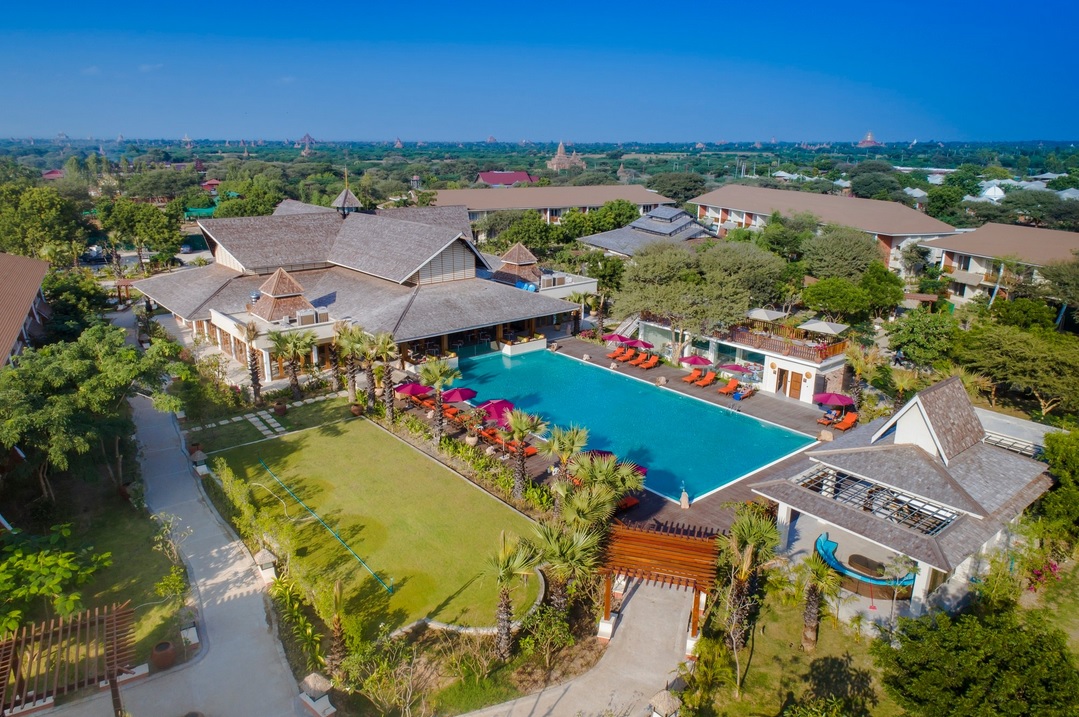
Sharing the resort completion photos and the state of the transplanted palms (Borassus flabellifer).
The palms were intentionally planted in straight rows to simulate the rows of palms that line the periphery of farm plots that grows peanuts and sesame seeds around this area.

Palms along the "row houses" looked like they are recovering well.

Ground shot of the above aerial shot.

Somewhere near the "row houses" as well.

Not showing much of the palm here, but rather the hot air balloons.

At another side of the development, where the main hall/reception building and swimming pool are located.

The transplanted palms lined one side of the swimming pool, and both side of the lawn.

Overlooking the ancient ruins of Bagan and hot air balloons.